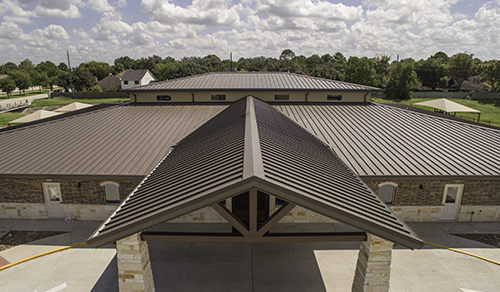
Understanding LEED for Green Metal Buildings

Designing and constructing sustainable buildings has become a mainstream expectation of most building owners. Whether for reduced energy costs, higher returns on investment, or as an organizational philosophy, “green” building solutions are in demand. Perhaps the best known and most often cited program to achieve these goals is the US Green Building Council’s (USGBC’s) LEED® rating system. While some may think that green buildings are more complicated and costly to build, that is not actually the case. This is especially true when metal building materials are used. In fact, metal buildings are an ideal and economical way to pursue sustainability goals and LEED certification. How? We break it down as follows:

LEED

The LEED® Program

The LEED program has been in use since 1998 and is now used worldwide. It is a voluntary, point-based rating system that allows for independent review and certification at different levels. These levels include Certified (40-49 points), Silver (50-59 points), Gold (60-79 points), or Platinum (80 or more points). Since it allows for choices in which points are pursued, innovation and flexibility are entirely possible as long as specific performance criteria are met. It also encourages collaborative and integrative design, construction and operation of the building.

Points are organized into six basic categories, many of which can be addressed through metal building design and construction, as summarized below.

  • Location and Transportation: Metal buildings can be manufactured and delivered to virtually any location. That means they can support LEED criteria for being located near neighborhoods with diverse uses, available mass transit, bicycle trails, or other sustainable amenities. Metal building parking areas can also be designed to promote sustainable practices for green vehicles and reduced pavement. This all contributes toward obtaining LEED eligibility.
  • Sustainable Sites: Adding a building to any site will certainly impact the natural environment already there. Delivering portions of a pre-engineered metal building package in a sequence to arrive as needed means that the staging area on-site can be minimized—reducing site impacts. Additionally, using a “cool metal roof” has been shown to reduce “heat island” effects on the surrounding site and also qualify for LEED.
  • Water Efficiency: Any design that reduces or eliminates the need for irrigation of plantings and other outdoor water uses is preferred. Incorporating metal roofing with gutters and downspouts, as is commonly done on metal buildings, allows opportunities to capture rainwater for irrigation or other uses. It also helps control water run-off from the roof and assists with good storm water control.
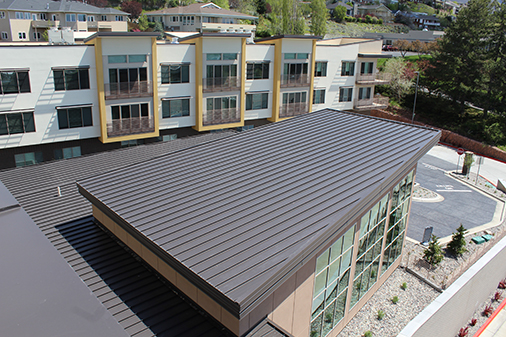
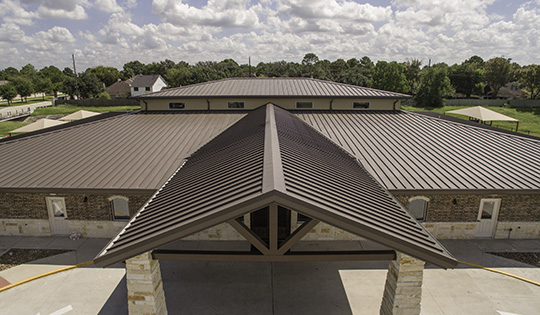
  • Energy and Atmosphere: Metal buildings can truly shine in this category. Creating a well-insulated and air-sealed building enclosure is the most important and cost-effective step in creating an energy conserving building. A variety of insulation methods for metal building roof and wall systems are used to achieve this. Typically, metal building construction uses one or more layers of fiberglass insulation and liners combined with sealant and air barriers. Alternatively, insulated metal panels (IMPs) provide all of these layers in a single manufactured sandwich panel with impressive performance. Windows, skylights and translucent roof panels can provide natural daylight, allowing electric lighting to be dimmed or turned off. For buildings seeking to generate their own electricity,  standing-seam metal roofing provides an ideal opportunity for the simplified installation of solar photovoltaic (PV) systems. Metal roofs generally provide a sustainable service life in excess of 40 years. This means they can outlast the PV array, thus avoiding costly roof replacements during most PV array lifespans.
  • Materials and Resources: Life Cycle Assessments (LCAs) are recognized by LEED as the most effective means to holistically assess the impacts that materials and processes have on the environment and on people. Fortunately, the Metal Building Manufacturer’s Association (MBMA) has collaborated with the Athena Sustainable Materials Institute and UL Environment to develop an industry-wide life cycle assessment report. There is also an Athena Impact Estimator that can help with providing LEED documentation. Metal buildings support exceptional environmental performance through the significant use of recycled steel and the reduced need for energy intensive concrete due to lighter weight buildings.
  • Indoor Environmental Quality: Most people spend much more time indoors than outside, which impacts human health. Therefore, LEED promotes or requires using materials that don’t contain or emit harmful substances. It also promotes design options for natural daylight, exterior views and acoustical control to promote psychological and emotional well-being. Metal buildings are routinely designed to readily incorporate components that help achieve these indoor qualities.

In addition, some LEED points are available for demonstrating innovation and addressing priorities within a geographic region.

Considering the qualities listed above, metal buildings clearly provide a prime opportunity to pursue LEED certification at any level. To find out more about the LEED rating system, visit https://new.usgbc.org/leed. To find out more about successfully designing and constructing metal buildings pursuing LEED certification, contact your local MBCI representative.

Advances in Ordering Metal Building Products Online

You’ve heard it before: “Online is the way of the future!” but do online solutions really meet the demands of traditional building? In recent blog posts, we’ve outlined the general benefits of using an online ordering platform to order metal building products. These include the customized metal roof and wall panels and trim MBCI offers. Beyond basic ordering functionalities (which are must-haves for an effective tool), there are additional features that manufacturers can incorporate to save you time and help you effectively build your projects when ordering metal online.

Web


Time-saving features that improve ordering metal online include:

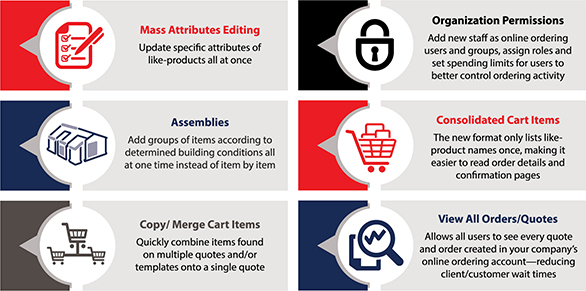
  • Copying and Merging Online Carts: Sophisticated online ordering tools now feature the ability to copy previously-created quotes, quote templates and/or orders. Once copied and/or merged, you can then modify item attributes like color and gauge to suit your preferences. These tools can also feature the ability to merge all items from several sources into a single, combined cart.
  • Consolidated Carts: Some online ordering tools take care to consider not just the actual tool functionality, but the experience people have when using it. Part of this is ensuring users can  quickly and easily view order details. Enhanced online ordering websites are attempting to achieve this by grouping like-products together—thus reducing the number of pages included for each quote or order. This not only cuts down on the amount of scroll time needed to view an entire quote or order, but enables you to quickly and easily see the most important details.
  • Changing Multiple Items at Once: Large quotes and orders often require that the same specifications apply across a series of different items. For example, you may want the same panels but in a different color, texture or  thickness. Likewise, you may even want to remove entire product types (like panels or trim). Instead of modifying cart items one at a time, you can now change to several products at once.
  • Complete Building Assemblies: Ordering metal online helps make getting the products you need easier and faster. But what if you know what you want to build, but aren’t sure about all the products you’ll need to get the job done? Online ordering tools like MBCI’s now provide a selection of “Building Assemblies” that group all products needed to complete a project into single, pre-defined bundles.These complete product assemblies allow you to put all the metal building products you need for an entire building into your online ordering cart with just a few clicks of your mouse. In addition to saving time and effort, these assemblies can include warranty protection if all other conditions are met. Note that it’s also possible to remove specific products (like fasteners, sealant, etc.) if you already have them.
  • Account Management Improvements: Controlling who can place orders has been a key benefit of many online ordering systems. However, based on customer feedback, MBCI has overhauled this part of our tool, making it much easier for your organization’s designated account administrator to add and modify users, as well as set access and spending limits and track user activity within the system. Overall, these seemingly basic improvements allow you to more effectively manage your business.
  • View All Quotes and Orders: Common to many e-commerce sites, only the user who creates the quotes and/or orders generated through their account can see them. However, because most organizations rely on several people collaborating to best service their customers, more sophisticated capabilities are required. New features now allow your company’s online account administrator to grant multiple users access to view quotes and orders while controlling the level of detail shared. This allows your team access to the information they need to effectively do their jobs while also protecting sensitive details at your discretion.

Industry-first features like these further support building contractors, project managers and suppliers in meeting the needs of their customers and clients when ordering metal online. MBCI has recognized the value tools and features like these can provide. As more people shift toward ordering metal online, we aim to continue enacting improvements that positively impact the overall MBCI ordering process.

To find out more about ordering metal online, including how to price, quote and place orders, visit http://www.mbci.com/shop or contact your local MBCI representative  today. To be the first to know when we launch new time-saving enhancements to our online ordering tool, stay tuned to our blog, email and social media posts.

Project Services for Metal Buildings and Roofing: Part 2

In our last blog posting, we identified the project services that are available from MBCI and the typical process that contractors for metal buildings and roofing might experience in using them. In this posting, we will take a closer look at why so many contractors are taking advantage of these very helpful services and reaping multiple benefits.

We start by pointing out that, while it hasn’t historically been well-known that these project manager led services are available, things are changing. MBCI in particular has seen a 40 percent increase in service requests in just the past 2 years! The biggest growth has occurred in the areas of custom designs, high-end architectural buildings, and projects that use insulated metal panels (IMPs). Nonetheless, it has been recognized that virtually all types of projects benefit from these services. Therefore, it should come as no surprise that the combined MBCI project management teams are servicing 100 to 150 projects at any one time.Project Services Part 2 March 2019 Blog

While it is hard to pinpoint why this impressive growth is happening in the use of project services, there are some commonly reported advantages such as the following:

Single Point of Contact: By having a designated project manager at the manufacturing company, communication is direct and streamlined. Further, the project manager takes care of everything from start to finish in regards to the metal building or roofing package. That means the contractor is freed up to focus on the site-specific aspects of the installation without needing to worry about managing the process on the manufacturer’s end.

Applicability: The range of building types that have benefitted from these services is all-encompassing, indicating that these services are applicable to virtually any metal building or roofing project. Project service teams are experienced in virtually all types of non-residential construction including commercial, retail, hospitality, institutional, schools, higher education, hospitals, government buildings, and many more.

Regional Expertise: The MBCI project service teams are organized so that they can focus on one of four specific regions of the United States. That means contractors receive attention from people who understand localized concerns.

Assistance During Design: When architects and engineers need some information on using metal building or roofing systems, the project manager can, as a courtesy, assist the contractor in providing design assistance. This includes helping designers become more familiar with metal product offerings and generally to become more informed and up to date on options. There is never an intent to lead the design or move the project in any particular direction.

Price Quotes: This is often the biggest and most noted benefit of working with the project service team. By having a relationship with a manufacturer, accurate quotes can be obtained quickly to allow bid deadlines to be met with a clear understanding of scope and confidence in the numbers.

Engineered Drawings: The ability to provide complete, engineered drawings is a big advantage instead of needing to find a local engineer take on that task.

Detailed Bill of Materials: All of the take-offs and ordering are done right from the information prepared by the project services team. There is no need for the contractor to spend the time on a separate take-off.

Scheduling Flexibility: The project manager can work with the contractor and work out a production, fabrication, and delivery schedule that meets the needs of the project. For large projects, this might mean phasing delivery of different parts of the package to suit the overall project schedule. Overall, projects have been done with coordinated schedules that are as short as 2 months, or phased up to 2-1/2 years.

Full Erection Drawings: Along with the full package of building materials, a full set of erection drawings are provided that serve as a virtual “installation manual” to help streamline the work in the field.

There are certainly other reasons for using these project services, but considering that most contractors don’t have the capabilities to do all of these things in-house, it can be a real time and money saver to take advantage of them from the manufacturer. Once contractors become aware of the availability of these services and the streamlined results, they often sign up for them repeatedly.

To find out more about how to successfully take advantage of these services and work with a project manager, contact your local MBCI representative.

Project Services for Metal Buildings and Roofing: Part 1

When a metal building or metal roofing project is being developed, it all starts with a design by an architect or engineer that may be rather standard, very custom, or somewhere in between. At some point a price for the metal portion of that design is requested from the contractor (i.e. an erector or sub-contractor to a general contractor) and of course that means turning to the metal building or roofing manufacturer for help.  Toward that end, MBCI offers a complete range of project services designed to streamline everything that needs to happen next in order to genuinely make life much easier for the contractor.

Project Services Part

What are these services? Essentially, there are four:

  • Estimating and price quoting services for public or private bids
  • Engineering services for the metal building systems involved
  • Drafting services for creation of shop drawings and erection drawings
  • Overall project management of all of the above plus coordination of production, shipping, and delivery.

The key to the success of these services is the assignment of a project manager who acts as the single point of contact between the contractor and the manufacturer throughout the entire project. Having a relationship with a metal building manufacturer who can assign such a project manager right up front is a huge benefit to the contractor. Here’s how the process might work in a standard project:

Cost Quote: The project manager will use the architectural drawings (submitted by the contractor) to have the project services team generate a lump sum price. That price is limited specifically to the metal building or roofing package with a clear description of what is included and what is not. That allows the contractor to develop the remaining costs for labor and equipment to erect the metal building along with any separate project costs as appropriate.

Detailed Drawings: Assuming the contractor is selected to proceed with the work, then an agreement on full project services can be made. Based on the architectural and/or engineering drawings, the project manager will then arrange for the detailed shop drawings to be prepared (including engineering stamp or seal if needed) so they can be submitted to the architect for review and approval. Note, that this will be a requirement of the manufacturer as well since they will not do take-offs from other people’s drawings for their manufactured systems. The shop drawings will notate all of the required components necessary to install and MBCI will order plus deliver all items required upon request/approval.

Scheduling and Production: Once all of the drawings are approved, then a full production schedule can be prepared with delivery dates identified. The project manager will oversee and coordinate the various people involved to see that things are progressing as planned and intervene as needed if any changes come up from the architect, owner, contractor, or manufacturer.

Delivery and Installation: When ready, the metal building package can be prepared and delivered according to the contractor’s schedule. Full erection drawings will be included which have enough detail that they are a virtual “instruction manual” for putting the building together.

That’s the typical process. In our next blog post, we will discuss the many reasons that contractors are taking advantage of these project services to save them time, money, and hassle. In the meantime, to find out more about how to successfully work together with MBCI, contact your local MBCI representative.

Choosing Metal Roofing Types

All metal roofing is not the same. There are different profiles in different shapes for different reasons and to suit different performance needs. How to choose? Here’s the process that metal building engineers go through at MBCI to zero in on the most economical selection that will still meet the performance requirements of a particular metal roof project.

Snap Together Trapezoidal Panels

Offered by MBCI under the name Ultra-Dek®, the trapezoidal shape is among the best for channeling water off of the roof. However, because of this shape, it is most appropriate for typical sloped roofs with single plane roofs areas free of valleys or hips. It’s snap together installation makes it quick and easy to install economically with wind resistance capabilities adequate for many situations. It also carries basic air leakage and water penetration testing approvals.

Mechanically Seamed Trapezoidal Panels

For roofs that require a higher degree of performance than snap together systems can provide, MBCI Double-Lok® panels can be considered. The mechanically field-seamed, trapezoidal legs provide higher wind and water resistance with test results to satisfy UL-90, FM ratings, and Miami Dade County approvals. This makes them ideal for many industrial, commercial, and architectural roofs without hips and valleys that are subject to higher wind and rain demands. While the material cost for the panel is the same as for the Ultra-Dek®, there is more labor cost due to the mechanical field-seaming compared to the snap together installation. The Double-Lok® panel is also used often for retrofit installations over pre-existing metal roofs either to update the roof or to provide additional insulation. In either case, there is no need to disrupt the existing roofing or structure below allowing for a very cost-effective solution. Check with MBCI on the details of how to properly do a retrofit with these panels though to be sure things work out as intended.

Vertical Legs with Mechanical Seams

BattenLok
Regardless of which metal roofing type you choose, they all use high grade steel in standard gauge thicknesses and can be specified in many colors.

In cases where the trapezoidal legs aren’t appropriate or desired, then vertical leg, standing seam metal panels are the next logical choice. The MBCI BattenLok® HS system uses 2” tall legs that are mechanically field-seamed once along each panel joint to create a high strength, structural standing seam roof system that can be installed directly over purlins or bar joists – no additional solid substrate is required. It is also capable of transitioning from roof to fascia with the use of accessory seam covers.

Double Seamed Vertical Legs

In cases where very rigorous weather conditions may be encountered, the MBCI SuperLok® roof panels provide the highest degree of roof performance. While the manufactured SuperLok® roof panel is essentially the same as the single seamed BattenLok® panel, the profile is modified slightly to allow for standing seams to be rolled over twice, thus creating a stronger, thicker seal between adjacent panels. Once again, there is no difference in the material cost between the two, but the added field-seaming step will obviously add to the labor cost of this roof choice. Nonetheless, that can be a small price to pay for the higher performance and added peace of mind that the system offers.

While we have pointed out the differences between these four different metal roofing choices, note that there are some basic similarities too. They all use high grade steel in standard gauge thicknesses and they can all be specified in the same wide choice of colors. They are all offered in multiple panel widths, although check with the manufacturer to be sure the width you prefer is available for the specific panel selected. They all can be used for low slope applications down to ¼” per foot except for the retrofit solution which requires a 3:12 pitch. Finally, they all do have some minor variations in the profile which can help with the final desired appearance of the finished roof on the building.

To find out more about the differences in roof deck types and how to choose the best ones for on a metal roof that you are involved with, contact your local MBCI representative, and sign up for our newsletter to subscribe to our blog.


Oil Canning and Flush Metal Wall Panels

Oil canning is a broad term in the world of metal panel products and is considered one of the most vexing issues facing metal panel installations. The Metal Construction Association (MCA) defines oil canning as a “visible waviness in the flat areas of metal roof and metal wall panels.” Oil canning, also known as elastic buckling or stress wrinkling, occurs in all types of metal panels. While it is a common concern, there are steps you can take to minimize the problem.

Here, we’ll focus specifically on oil canning/distortion with metal flush wall systems, which for MBCI products includes our FW Panels and Designer Series. The type of oil canning that occurs with flush wall systems is not caused by anything dealing with the product itself or with how it’s manufactured. Rather, it is a consequence of what installers are putting the metal panels on and how the installation is done.

Installers must verify the substructure is in frame to prevent oil canning of panels.
Installers must correct any out-of-plane areas of the substructure to prevent metal panels from oil canning.

The simplest way to explain the phenomenon is that if the substructure is out of plane, i.e., not in alignment, stresses are put onto the panels that will create an appearance of oil canning. After all, as the old adage goes, you only get out what you put in. In the case of flush metal wall systems, the panels will look no better than what they are put on top of. If the substructure is wavy, out of plane, up or down, in or out, that condition will affect the panels’ performance and appearance.

Certain tolerances will have an effect on the panels’ appearance. With MBCI’s FW and Designer panels, tolerances would be 1/4 inch and 20 feet outward (away from two attachment points) and 0 inch and 20 feet inward. This means that if panels are forced into an inverted convex position, they will show stress rippling or oil canning more severely than when they’re stretched over a concave position, i.e., there can be some tolerance outward but zero inward.

With these types of panels, the biggest concerns with oil canning/distortion are aesthetics, but performance problems are also of concern, including possible engagement or sealing of the side joints.

Minimizing Oil Canning/Distortion of Panels

Prior to installation, installers should be checking the substructure with string lines or lasers and correcting or shimming any areas that are out of plane, especially since oftentimes substructures, such as stud walls or structural walls that the metal panels are attached to, are installed by other trades. Metal panel installers need to scrutinize each aspect for alignment and then either correct or shim to bring it within tolerance and within plane.

As is true with any metal panel product, for best results, proper handling and installation go a long way towards preventing the problem of oil canning in the field.

To find out more on how to minimize oil canning on your MBCI metal wall panels, contact your local MBCI representative, and sign up for our newsletter to subscribe to our blog.

Appropriate Standing Seam Clips for Roof Panels

Part of the beauty and appeal of standing seam metal roofs is that the fasteners holding the metal panels in place are concealed. That gives the roof its clean, continuous appearance that is often desirable, but it also avoids the issue of potential roof leaks around exposed through-fasteners. Concealed fastening doesn’t mean that there aren’t any fasteners, though, it just means they are installed out of sight – underneath the panels. The industry standard approach is to use a metal clip that fits over the edge of a panel and that is secured with a screw type fastener to the structure or substrate below. Then it is covered by an adjacent panel or trim. The important thing to know is that not all panel clips are made the same – for good reasons.

What determines the type of panel clip to use? Here are the most common things to keep in mind:

The Manufacturer

Each manufacturer of metal roofing typically has a range of metal panel types, profiles, and brands that have their own traits and characteristics. As such, they need clips to match and fit with the manufactured panels. Hence, the first place to start with panel clip selection, is for the roofing manufacturer to be clear on the options and choices available that are compatible with their roofing products.

Building Size and Type

Fixed clips (left) and floating clips (right) are two of the most commonly used types of clips.
Fixed clips (left) and floating clips (right) are two commonly used types of clips.

Manufactured metal buildings that include metal roofing commonly use very predictable, coordinated systems. Accordingly, a standard, one piece, “utility clip” is commonly used, primarily for snap together roof panels, on metal buildings that do not exceed certain widths causing undue expansion and contraction. One piece clips allow the roofing panels to expand and contract within the clip profile, but there are limits based on the amount of movement tolerated. Alternatively, in projects where the roofing is attached to something other than a metal building frame or where standing seams are used to secure the panels together, it is advisable to use a two-piece or “floating” clip. In these cases, a base piece is secured to the structure or substrate and the clip fits both into the base and over the roofing panel where it is seamed or folded into the vertical leg of the panel. Using this approach, the clip expands and contracts directly with the metal panel thus moving across the base and keeping the roofing attached.

Insulation

Roof insulation comes in different thicknesses, appropriately so for different climate zones and different roof designs. Since energy codes require at least some of the insulation to fit between the underside of the metal roofing panel and the structure (i.e. above the metal roofing purlins), the metal panel clip needs to be the right height to reach the full height of the insulation up to the top of the roof panel. Hence, manufacturers offer different sizes and heights of panel clips designed to work with different heights of insulation. In many cases, they also recommend the use of a thermal spacer underneath the clip to separate it thermally from the steel structure below. Note that the thermal spacer thickness is dependent on the insulation thickness over the steel purlin only, not the thickness of any insulation under the purlin.

A certified installer should install your standing seam roof to ensure proper installation of clips.

Other Factors

The panel clips connect the roof panels to the roof structure, so they need to be installed in a manner that allows them to do that job under normal and demanding circumstances. The driving issue in this case is not keeping the panel down, but preventing it from blowing off in a strong wind. Therefore, a structural engineer or other design professional may need to determine the proper spacing of the clips, the type and size of fasteners (i.e. screws) to use, or similar important details. Similarly, the proper installation of clips so that they seat and nest the way they are intended, means that qualified and certified installers / erectors should be used. In this way, roofing crews with the needed experience and training can help assure that the whole roofing system, including the panel clips, are installed properly.

To find out more about the most appropriate panel clips to use on a metal roof that you are involved with, contact your local MBCI representative.

Built to Move: Building for Expansion and Contraction with Standing Seam Roofs

Standing seam roof (SSR) systems are built to move, designed to account for necessary—and often substantial—expansion and contraction due to thermal conditions. In fact, for many builders, this fact is one of the main reasons SSRs are such an attractive option.

Even with this expectation baked into the mix, many contractors and installers may still make a wrong turn when tying the SSR into adjacent structures and other building edge conditions. By not allowing for that same expansion and contraction on trims and transitions, problems can ensue.

Fixed and Floating Clips

One main consideration in planning for this movement is the clip type used. Standing seam metal panel clips are designed specifically to interact with their corresponding roof panels in order to allow movement (both interior and exterior) caused by thermal changes. The clips, which are part of the concealed fastening system used with SSRs, provide improved aesthetics in addition to durability and protection from the elements.

Fixed Clip (left) Floating / Sliding Clip (right)

The two main options are fixed clips (one-piece) and floating/sliding clips (two-piece). Fixed clips are limited by and dependent on the substrate’s ability to expand and contract with the roof system, whereas floating/sliding clips permit the panels to expand and contract within the clip itself. These clips will allow for greater thermal movement of the panel, which is independent of the substrate while still ensuring the panel remains secured. Regardless of which clip is utilized, you are not going to stop the expansion and contraction. You can, however, have some control of the direction of movement, and, therefore, can address or compensate for the degree of this movement when tied into adjacent structures.

While standing seam roofs are designed for movement, correctly tying it to the rest of the structure is crucial.

Standing seam roofs with floating/sliding clips require one end of the panel run to be “pinned” and the other end to be “moveable” in order to permit expansion and contraction. The “pinned” point of the system is typically the low eave, although it doesn’t have to be. There will be instances when it becomes beneficial to “pin” the roof at the complicated transition or tie-in point and design the roof system to expand/contract outward from this location. This can eliminate potentially “troublesome” areas from the equation on having to deal with the roof movement, and in turn can make them easier to install and have greater weathertightness success.

With all this in mind, it is important to always check with the manufacturer to determine the best clip and design layout to use with any given SSR system and be aware of how much and in what direction the expansion and contraction is going to occur.

Tying In

Not only does the building move, but anything it ties into has to be able to permit that movement, e.g., the edges or perimeter of the buildings. Manufacturers can provide both longitudinal and transverse transitions that allow for thermal movement so that when they tie into an adjacent structure it doesn’t restrict the panel from moving. Not adequately compensating for or preventing that movement entirely can lead to potential pitfalls, such as oil canning. It could also lead to fasteners backing out and slotting of holes. Bottom line, any time that we try to confine or restrict the roof from doing what it was meant to do (move!), we inevitably run the risk of damaging the panel not just aesthetically but more importantly, from a weathertightness standpoint.

Slip joint being used for transverse tie-in between adjacent roof surfaces.

The Role of Expansion

Issues can arise not just when tying panels into adjacent structures. Because of the roof’s size and magnitude of potential movement,  you may/will have to implement expansion/contraction capability of various degrees into the perimeter of the roofing system itself. In these cases, this is why manufacturers offer roof accessories as ridge expansions, edge trim expansions, panel expansions, gutter expansions and other details to account for not only the roof movement but the perimeter trims that are secured from the roof system to the wall system.

Parallel Roof Transition (left) and Perpendicular Roof Transition (right)

Know Your Details

The key takeaway here is to remember that if you’re considering a standing seam roof for a project, then you need to make sure that the designer looks at every detail from the manufacturer and accounts for movement of the roof panel, such as how it ties into adjacent structures or simply how the edge or perimeter of the building is terminating to make sure they permit that expansion and contraction. Know what you’re buying and understand that if the roof you’re purchasing is meant to expand and contract, everything that ties into it has to be able to expand and contract as well.

To find out more about how to correctly install your standing seam roof, contact your local MBCI representative.

A Guide to Selecting the Right Metal Roof Panel

With the great variety on the market, one of the main questions we, as metal roof panel manufacturers, get from customers is “How do I select the right panel for my project?” The answer can generally be found by examining a number of criteria, including the properties of the roof, the region and climate, geometry, slope, warranty type…among other key factors.

Here we will provide a brief overview of the various factors that should be considered when narrowing down the choices.

Determining Factors

Slope-BattenLok
Steep slope roofs will usually be more expensive than low-slope roofs, but steep slope roofs have the ability to prevent ponding water and have higher snow loads.

1. Slope— Slope is the first consideration as just this one aspect will eliminate certain panels, making it easier to narrow down options right from the start. The two types of roof slopes are low slope and steep slope.

  • A low-slope roof, commonly found in commercial applications, is one whose slope is less than 3:12. The benefits include a simpler geometry that is often much less expensive to construct, and the requirement of fewer materials than a steep slope, thereby reducing material costs.
  • A steep slope roof, more common in residential construction, is one whose slope is greater than 3:12. Steeper slopes are ideal for areas that have higher snow loads and will also prevent the possibility of ponding water on the roof. Since the roof is a visible part of the structure, choosing a metal roof for residential construction often skews more toward aesthetic considerations.

2. Location/Climate— The location and climate of the project is a factor, specifically when looking at certifications/regulatory product approvals, which will limit the panels you can you use within specific regions. This is most relevant to Dade County, the state of Florida, and the Texas Coast, as well as certain snow regions.

3. Specified test standards—Often times, you may need to specify UL 580 or Factory Mutual Insurance Design.

4. Engineering Design—Due to the roof pressure acting on the buildings, engineering design factors eliminate some products because they’re simply not strong enough. This is an area that needs true technical expertise. For that reason, make sure to get a professional engineer to design the roof system in order to determine the correct panel for the project. Also, check with the manufacturer to determine if they have panels that have been tested to certain test standards. If they do not have the testing on a product, that in itself can exclude a particular panel.

5. Geometry—In its most basic terms, roof geometry is an overview of what the finished roof will look like, including special conditions, such as hips, valleys and ridges. The various conditions that go along with specific roof types will determine if a roof geometry is simple or complicated—which will affect the type of panel that can—and can’t—be used. For instance, a Double-Lok® roof panel can be used on a low slope roof—it can go down to 1/4:12. However, if a low roof slope condition has a valley, you may want to avoid a Double-Lok® panel since this product is more difficult to use in a valley situation.

Standing Seam - LokSeam
The LokSeam® roof pictured above is a standing seam roof, one of the two main types of roof systems.

6. Panel type— Panel types can be broken out into two main types: standing seam and through-fastened. The choice of specific product within these general categories depends on a number of considerations, including aesthetics and weathertightness warranties. If your project calls for either standing seam OR through-fastened, that will eliminate about half the types right off the bat.

  • Standing Seam Roof Systems
    In basic terms, there are four unique styles of metal standing seam panels: Double lock seam, symmetrical seam, one-piece snap-lock interlock and two-piece snap-lock interlock. These styles can be further delineated by seam shape or profile, i.e. trapezoidal rib, vertical rib, square rib and tee rib.
  • Through-Fastened Roof Systems
    Exposed, or through-fastened panels, are available in a variety of widths, usually from two to three feet wide. They also come in various rib shapes, heights and spacings. Typical gauges are 29 and 26, but they also come in 24 and 22 gauge. There are also structural and non-structural through-fastened panels. Structural panels are capable of spanning across purlins or other secondary framing members such as joists or beams. Non-structural panels must be installed over a solid deck. Through-fastened roofs are best suited to small- and medium-sized metal buildings and residential applications. In both instances, the panel runs are limited to shorter lengths where thermal movement is typically not a problem.

7. Substrate— Examples of substrates are open framing, plywood, and metal deck. Some panels can’t be attached, for instance, to open framing but almost every type of panel can attach to plywood.

8. Required Weathertightness Warranties— If a weathertightness warranty is a requirement, your options are down to the only panels offered with that guarantee—eliminating all the through-fastened panels.

Looking to the Manufacturer for Help

While specifiers need to take that initial look at all the determining factors, the choices can still feel overwhelming. Once you’ve eliminated the panels that surely won’t work, you will still likely be left with many strong choices. The metal panel manufacturer can guide you to that decision. We encourage you to contact the MBCI team of experts to help further narrow down the choices in order to finalize what is the best metal roof panel for your project. For more guidance on finding the right roof panel for your project, stay tuned for our white paper coming soon.

Quote Online. Order Online. Build Your Business.

The age of electronic commerce is firmly in place. It seems that just about anything can be ordered and paid for online then shipped directly to customers. Since this makes the process of buying and selling so much more convenient and efficient, it is exciting to see that this method can be used to order metal roof and wall panels, trim, accessories and even steel-curtain roll-up doors! MBCI is among one of the first metal building component manufacturers to offer an online ordering service to contractors, building owners and other customers. Here are some of the benefits to those who take advantage of this very timely e-commerce tool:

It's as simple as filling out your contact and company information to get started!
It’s as simple as filling out your contact and company information to get started!

Simple and Safe Account Set-Up

Getting started using an online ordering website is usually quick and easy and only requires that you provide little more than basic company and contact information. Once those details are provided, your account verification and activation generally takes a few business days. This may seem like a long time to some—particularly in comparison to those e-commerce businesses that allow almost immediate account activation and even ordering by guests without accounts. However, instantaneous account approval methods often don’t allow for the customization and specialized pricing that online ordering services like MBCI’s do, and that verification and customization does take some time.

For those who have already done business with their selected retailer offline, historical account information can typically be linked to their new online account, including any unique pricing agreements. And, of course, sensitive information held within online ordering accounts can be kept safe using appropriate online security methods and password protection to keep everyone’s mind at ease when doing business online.

Immediate and Accurate Product Pricing

The biggest benefit of online ordering tools is often the convenience of getting quick, accurate, pricing information anytime it is needed. When a quote is sought for a project of any size, customers can simply log into their online ordering account and view up-to-date information related to all of their quote queries and order transactions. Some online ordering platforms like MBCI’s even include a “Quick Price” tool that enables users to search for specific products and set customized attributes for them to get an accurate price for that item immediately, all based on either unique or general pricing agreements. An added bonus is that when changes are made to pricing agreements, quotes and preferences, their impact can be seen in real time.

Time-Saving Features

When working under a deadline, you don’t always have time to wait for a sales representative to process your order manually. And besides, who has time to wait even when there are no deadlines! Instead of relying on others to receive accurate quotes each time you need to find pricing or place an order, you can use an online ordering tool to save time by:

The Quick Price Tool allows for users to get immediate accurate pricing on any product (pricing subject to change).
The Quick Price Tool allows for users to get immediate accurate pricing on any product.(pricing subject to change)
  • creating as many custom quotes as you like and submitting orders anytime, anywhere and from any device—even when sales offices are closed
  • saving items as favorites for quick reference
  • creating custom quote templates for frequently-ordered product combinations

While online ordering is inherently faster than more traditional processes, these tools help speed up the process even further.

Intuitive Order Checkout Process

Once you’ve customized the products you need for your project(s) and added them to your cart, you are now ready to checkout. Online ordering makes this easy by providing fields that capture all necessary information like shipping address, delivery instructions, jobsite contact and more to help prevent delays in getting your material delivered. In addition, a variety of payment methods are often available, including purchase orders and even credit cards, allowing you to select the method you prefer best. An added benefit of ordering online is that once you’ve set your preferences, your account remembers them and helps you reduce the repeated entry of information that rarely changes.

Order Status Visibility 

Another benefit to doing business online is that anytime you need to know the status of an in-progress or already-completed order, a quick glance at your online account should provide all the information you need. In most cases, you can check an order status by simply clicking on it to view details like the order confirmation and shipping status, which can also be easily shared with colleagues.

Account Management

Using the eCommerce tool, you can manage spending limits and employee permissions with the click of a few buttons.

Most online ordering websites feature a robust suite of administrative tools that make it possible to easily:

  • manage employee access
  • designate which employees are allowed to purchase
  • set spending limits on those employees and
  • assign customers to specific employees within a sales team.

In addition, account management tools can make it very easy to view detailed reporting that shows order trends by product type, order time-frame and more. They also allow you to enable notifications to track updates and changes and build an integrated, company-wide address book to expedite order checkout.

With benefits like those listed above, it’s no wonder that businesses are transitioning to this digital means of operation. To find out more about how MBCI’s online ordering tool can help you quickly create quotes with accurate pricing, order the products you need to start building, and save time so you can focus on your business, visit http://www.mbci.com/shop/ or contact your local MBCI representative.

Find a sales representative