How Energy Codes Influence Metal Roof Panel Selection

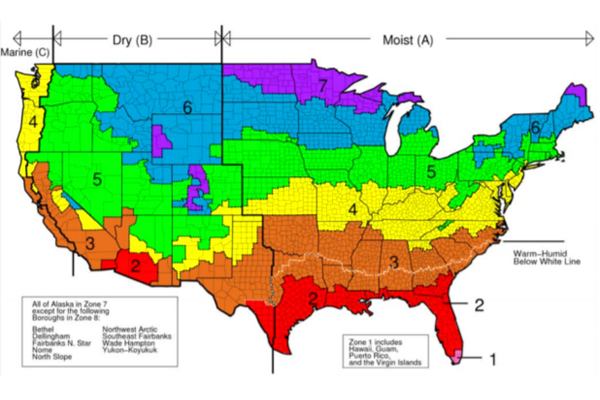
On a very basic level, specifiers can look at a climate zone map and get an idea of the metal roof panel best suited to a specific geographic region. The issue, however, is actually much more complex. One must know that overlooking any detail could result, not only in less-than-ideal performance, but also in costly project fail, often related to the project not meeting required energy codes or other standards. With this in mind, an important initial question to consider is how to select metal roof panels that conform to new and fast-changing energy codes and their designated climate zones.

To begin making wise considerations, the architect must know what codes are in play. For instance, is it IECC or ASHRAE 90.1? Which year of the code/standard? Are there additional local code requirements? Even if a state adopts a particular energy code, it doesn’t necessarily mean that all jurisdictions will adopt the code at the same time. Along with this, some local jurisdictions may have their own or additional requirements. To be successful, it is imperative to know what the regional project goals and requirements are. This will require research prior to specifying the metal roof panel and its assembly.

Using IECC and ASHRAE 90.1 for Energy Code Compliance

Three of the basic metal building roof panel types are single-skin standing seam, screw-down and insulated metal panels (IMPs). When using the tables in IECC and ASHRAE 90.1 for metal building roofs it must be remembered that these tables are based on single-skin standing seam roof panels and purlins that are 5′ on center. The tables provide the required R-values and/or U-factors based on climate zones, along with other assembly requirements noted with each tables. In the Appendix of some versions of ASHRAE 90.1, there are allowances for modified roof assemblies, including screw-down metal roofs.
Energy Code
DOE-Developed Climate Zone Map

Often, in certain climate zones, the required R-values and U-factors may be so stringent that the logical first consideration is to use insulated metal panels. IMPs are a great choice for offering high insulation properties in a top-of-the-line product and the R-values and U-factors are readily available for use in compliance calculations.

Keep in mind when deviating from the prescribed assemblies in IECC and ASHRAE 90.1, calculations will be required to show compliance, along with modeling and/or the use of approved compliance software, such as COMcheck.

Making Informed Decisions

Selecting the right metal roof panel is an important step to achieving energy code compliance. Even though energy codes can be complex and are constantly evolving, by making informed metal roof panel selections you will add to the overall success of your project.


Top Five Tips:

  • Know your code. Find out what energy code is required for your project.
  • Know your zone. Requirements vary by climate zone. Identify your project’s climate zone.
  • Understand your options. Deviating from specified assemblies will require approved proof of compliance.
  • Choose wisely. Research the properties and assembly requirements of any metal roof panel. Use this information in conjunction with energy code requirements to make wise choices.
  • Call with questions. Call the manufacturer with questions before you get too far down the road.
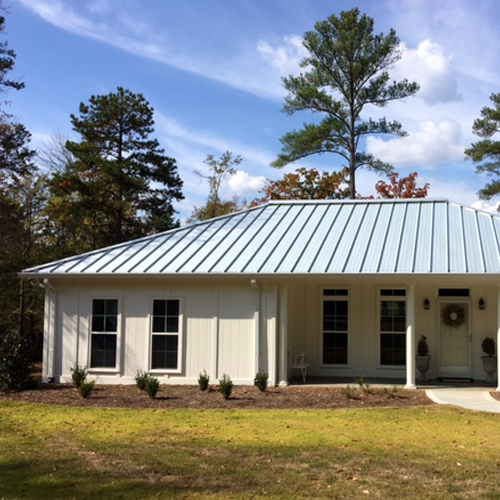
Reducing Peak Demand Costs with Cool Metal Roofs

Among the many benefits offered by cool roofs—including a decrease in urban heat island effect or increased roof system longevity—perhaps the most significant is a reduction in peak demand energy usage which directly affects building expenses.

Peak demand is the highest point in the day at which a building draws electrical consumption. A facility’s monthly utility rates are largely determined by the power usage level at this time, so anything that can be done to drive usage down will significantly reduce utility costs. As evidenced by their test values, cool roofs are an effective way to decrease air conditioning loads during peak demand times.

Cool roof values are expressed in terms of solar reflectance and thermal emissivity. The combination of these values is used to determine how hot a surface will become by its ability to reflect solar energy and radiate heat away from itself. Cool roofsare capable of reflecting solar heat away from a building by more than 70 percent. In fact, the U.S. Environmental Protection Agency estimates that ENERGY STAR® qualified roofing products can lower roof surface temperatures by up to 50°F.

According to Jeff Steuben, executive director, and Carolyn Richter, communications manager, Cool Roof Rating Council (CRRC), in a recent Florida Roofing article, “Building occupants can experience improved comfort as compared to a conventional dark roof, as the building’s interior is subject to less thermal flux and stays cooler during warm seasons,” and, “Reduced indoor temperatures lead to energy savings from reduced cooling energy loads.”

Along these lines, contractors can also access a CRRC-provided listing of cool roof rebates, codes and voluntary cool roof programs at: www.coolroofs.org/resources/rebates-and-codes.

Cool Roofing Longevity

In addition to energy efficiency, cool metal roofs are known for extended durability and longevity, with most products offering a 40-year finish warranty.

In fact, a well-noted extensive study, Natural Exposure Testing in California, conducted by the Oak Ridge National Laboratory, found that pre-painted metal roofing maintained higher levels of reflectance, over a three-year period, due to its ability to shed particulate matter, as compared to conventional roofing materials. Further, pre-painted metal roofing has been found to retain 95 percent of its initial solar reflectance over this same three-year period.
Increasing performance and energy savings, solar reflective pigments in cool metal roofs offer higher total solar reflectance and thermal emittance, even in darker colors. With cool roof technology, the ability for the roof to store heat and radiate that heat into the building after sundown is dramatically reduced.

Cool Roofs
Heitmann Residence featuring a Cool Metal Roof

Cool metal roofs are proven to deliver environmental and performance benefits, of which the most significant to building owners is their contribution to the bottom line. Although savings will vary based upon geography, materials and insulation, the U.S. Environmental Protection Agency estimates that reflective roofs can save up to 40 percent of a building’s cooling energy costs.

When utilizing the U.S. Department of Energy’s Cool Roof Peak Calculator, contractors will discover that the total value of energy savings offered by a cool roof averages more than $1,000 annually in most climate zones for a typical commercial building. Furthermore, this applies to both cool roofing installed over both existing roof insulation and new insulation.

Proven Strategy

As established by documented study and significant heat build-up reduction levels, cool roofs are a proven strategy for supporting longer lasting roofs, reducing both utility costs and decreasing a building’s environmental footprint as Steuben and Richter conclude, “cool roofs are one of the most effective ways to obtain energy savings and environmental rewards through building envelope design and re-roofing projects.”

Knowing When to Call the Metal Manufacturer: Part 1

Metal panel installers have a tough job—not only navigating the details of the task at hand but also being confident enough to know when to seek the manufacturer’s guidance. Part of overseeing a successful project is for the installer to know when something is out of his or her comfort zone, beyond their expertise, or just doesn’t look or feel right. And when that’s the case, it’s imperative to call on the manufacturer for input before it’s too late.

Technical support, such as MBCI’s Ask the Technical Expert, can be most useful for answering upfront general product questions. Once the project has started or material is on the jobsite, it’s generally preferable for the installer to go through their sales person or field service/customer service representative rather than sending a question via a website.

When to Seek Assistance from the Manufacturer

First things first: The installer should study the installation manual and construction drawings. If, after that, he or she is experiencing a problem—for instance, the panel doesn’t look right, it’s not engaging properly, it’s not meeting the tolerances stated in the manual, the fasteners that are called out in the drawings are not working or are even missing—then contacting the manufacturer should be the next step. That one simple call can save a lot of time in potential headaches.

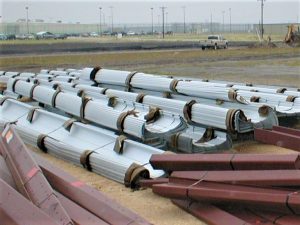
Improper Storage of Metal Panels
The above image depicts damage to metal panels caused by improper storage, rendering them unable to install properly.


While it’s not the manufacturer’s direct responsibility to make sure the installer is doing the job on site per the drawing details, a reputable manufacturer can at least provide recommendations when asked how to possibly alleviate or mitigate any number of potential pitfalls, or share common oversights that other installers have made—and how to avoid those same mistakes.

Top Circumstances

Here are two of the top circumstances under which MBCI recommends immediately reaching out to the manufacturer:

  1. Damage to the physical panel itself. If a customer receives materials and there’s suspected or noticeable damage to it, he or she may or may not know what impact that damage could initially have on the system. Notify the manufacturer immediately to assess if it’s a minor issue or if the panels should not be installed because it will be detrimental to the system. No one wants to have to reorder or wait for new materials, but it’s worse to wait until after installation when the impact of removing/replacing is significantly more costly and time-consuming.
  2. Fasteners. Contact the manufacturer if the substrate on site changes in any form from the project details, there is any difficulty with the screws themselves engaging, or any problems with the fastener type. When installing fasteners, make sure to use the ones per the installation details. The manufacturer can assist in verifying the correct fastener is being used in the correct location per the details and per the substrate on site. There could be situations where the installer is not accurately reading the drawing or has substituted an alternative screw not supplied by the manufacturer. Don’t assume. Instead, call.

There are, of course, other scenarios when a call to the manufacturer will save time, money and aggravation for all parties involved in an installation, including alignment and substrate issues, the addition of accessories, and problems with panel engagement. In Part 2 of this topic, we will go into more detail on these additional circumstances.

For more information on metal roof and wall products and training, MBCI offers courses through its Metal Institute. These courses are available for general training purposes or for those seeking installer certification.

Alignment Tolerances of Substrates for Metal Panels

Installers take note! It is your responsibility to ensure the substrate material over which you place the metal panels is in proper alignment before beginning installation. Otherwise, you can suffer some significant negative impacts on the overall appearance of the system.

As we’ve discussed in a previous blog article, Choosing Proper Substrates for Metal Roofing Systems, the substrate (or substructure) rests underneath the metal panels is a key part of the roofing or wall system. It serves two main functions: to act as a base to which the metal material is attached and to serve as a structural member to transfer loads to the primary framing system.

Knowledge is Power

Too many times, inexperienced metal building sheeting installers or sheeting-only contractors may not realize how big an impact alignment can have; it’s very easy to get too far into the process before recognizing there’s a problem. The issues must be dealt with at the very beginning of the process as well as the way through the installation of the panel system, whether it’s roof or wall panel installation, and must be checked frequently.

Major Misconception

One common misconception, especially for those new to the panel system, is that aesthetic anomalies are a result of panel quality. When troubleshooting, the manufacturer will ask a series of questions about the installation and alignment. However, by that stage, the installer may be beyond the point where it’s an easy fix, depending on the circumstances.

Key Considerations

  1. Understand the general panel installation characteristics by reading the installation manual. Become familiar with which screws and clips to use, and how the panels physically connect as well as types of insulation systems that work well with the panel system and if there are any limitations related to insulation types or thicknesses.
  2. Installers must be certain that the substrate material they’re installing over, whether metal or wood or something else, has been properly erected and properly aligned before panel installation begins.
  3. As they’re putting the panels over the substrate, installers should be checking the alignment, whether vertically/horizontally along the leading edge of the panel or inward and outward on the panel itself. With most metal panels, major variances in the substructure will cause the panel to accentuate any errors. As a result, the panels will look unattractive and be difficult to install.
  4. When the panel installation first begins, the installer might not immediately recognize there’s a problem. A variance in the steel or in the substructure can have a big impact, which won’t be known until it’s too late. As an example, consider erecting half a wall on a cloudy day without checking alignment. At the end of the day, it looks fine, but the next day when the sun is shining on it, the “aesthetic delights” due to misalignment are obvious.
  5. Check panels during installation for any damage due to handling, surface irregularities and how it engages or lays on the steel. Do not install any “suspect” panels and contact the manufacturer as needed.

Types of Problems with Alignment

  • Different types of panels can react differently to a substructure out of alignment. Some are more forgiving, and some are terribly unforgiving.
  • Overdriving fasteners combined with improper alignment is a killer 1-2 punch.
  • If alignment is not properly addressed/corrected prior, installers often try to push and pull the panel out of plane, resulting in “oil canning,” a common rippling effect that occurs with improper installation. It should be noted, this often is a direct result of the substrate and/or improper installation and does not have any bearing on performance, weather-tightness and warranty. It doesn’t look nice but is not a cause for rejection.
  • If the steel is out of alignment, the panels can be difficult to engage and perform the way they should.

What Can You Do?

Using a level, laser or a string line, an installer can measure/check the amount that the substructure is either going in or out of plane and correct as needed. For instance, the plane is zero mark-perfectly plumb, perfectly level. There’s an allowable tolerance that the substructure can be out of plane and still be acceptable. Manufacturers often publish recommended tolerances that should always be reviewed. The preferred tolerance being convex (outward) and never concave (inward).

Other Considerations

The main takeaway here is that steps should be taken to prepare a substructure to properly receive the metal panels. Then, diligently check as panels are being installed to ensure proper alignment is maintained and the installer is not inadvertently pushing and pulling them out of alignment, which could result in less than favorable final appearance.

Nice Curves! Stunning Architecture with Curved Roofing and Walls

Breaking away from simpler panels, more and more architects are experimenting with arched and curved metal roofing and wall panels to upgrade their designs. This enables designers to incorporate exciting elements like concave and convex curving, not as feasible with other cladding materials.

Combined with unique angles, increased edge finishing options, appealing gutter options and greater compatibility with shingle types, architects now have access to a greater assortment of mix-and-match options.

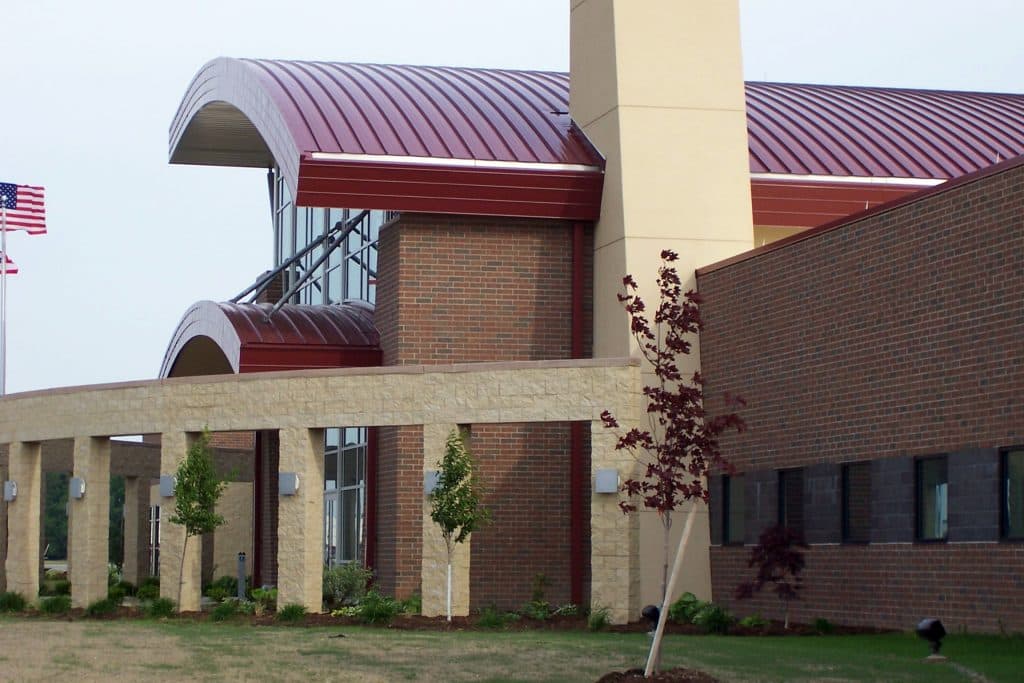
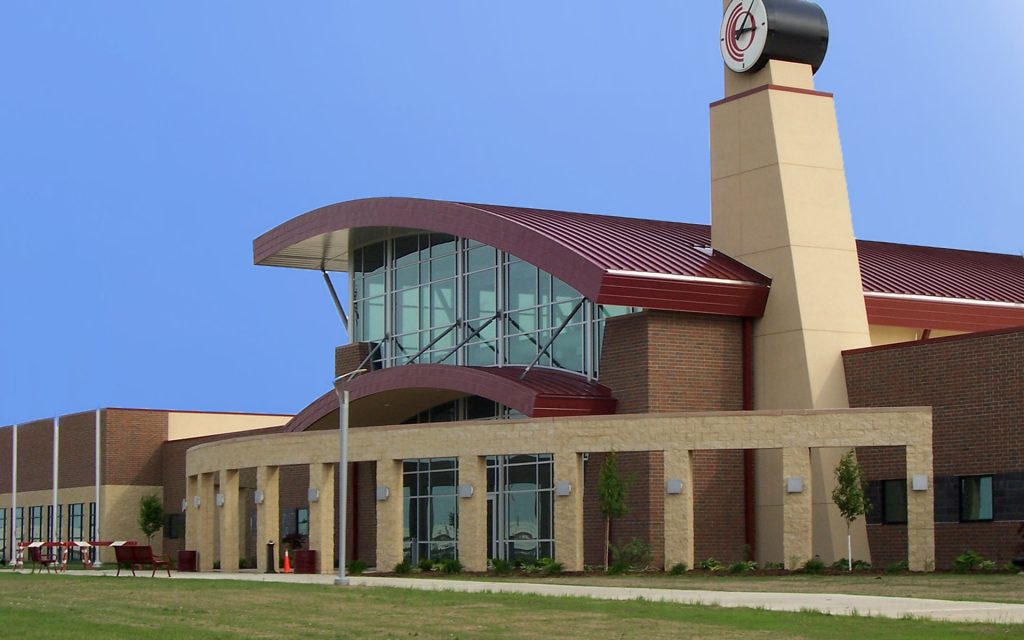
For example, at Owens Community College in Findlay, Ohio, a regal red, double-curved canopy crowns the curtainwall with 15,500 square feet of 22-gauge curved metal roof panels. Designed by Rooney Clinger Murray Architects, the structural roofing panel system, fabricated by MBCI, is ASTM tested for air infiltration and water penetration, and incorporates a 2-inch tall standing seam that was field seamed during the installation process. The contractor, Charles Construction Services, won the American General Contractors (AGC) Build Ohio Award for “New Construction Under $10 Million.”

Owens Community College
For Owens Community College, the Curved BattenLok® metal panels in red accentuate the arch of the campus, making it the focal point of the building.

Another noteworthy curved design example is the Central Los Angeles Area High School #9, designed by HMC Architects. “Metal enabled us to clad buildings of different geometries, including curved geometries, in one material, while also giving them a special appearance,” reported Kerstin Kohl, spokesperson for the project’s design architect, COOP HIMMELB(L)AU, in a Metal Construction Association case study, Steeling Art for Students.

Using CAD and BIM for Curved Metal Panels

For designing and fine-tuning curved metal creations, the latest CAD and BIM features are key tools for architects.

In creating the “geometry that has been freed from the relentlessness of the orthogonal layout,” as described by Mark Dewalt, AIA, principal at Valerio Dewalt Train, in a recent article in Metal Architecture magazine, New Trends in Metal Architecture, designers are using CAD in shop drawings to support unique façade fabrication.

“The use of computer design to warp and twist and perforate will give metal greater longevity, added Kevin Marshall, AIA, LEED AP BD+C, associate architect, Integrated Design Solutions.

Similarly, BIM software is further supporting enhanced compatibility with metal roof and wall designs with newer features such as automated light gauge steel wall framing work and the ability to more easily configure supporting structures, openings, complex L or T connections and service hole positions while providing photorealistic renderings so that the client can see exactly how their building will look once built.

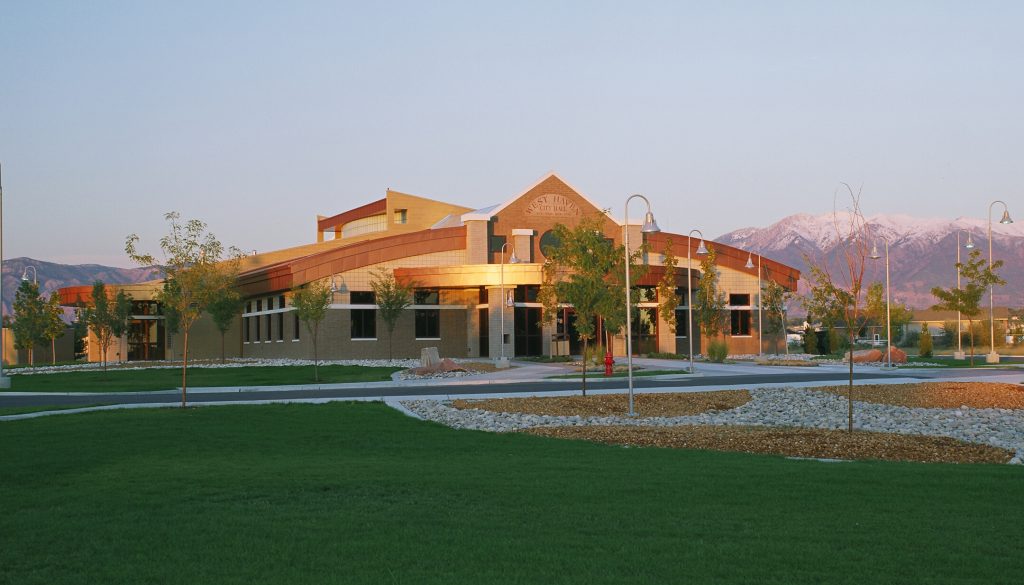
West Haven City Hall
West Haven City Hall combines MBCI’s Curved BattenLok® in Copper Metallic with Artisan® Series and Flat Sheet.

Ensuring a Tight Building Enclosure with Curves

As with any roofing type, designing and installing a tight building enclosure for curved roofing and walls is essential for delivering a high performing building.

For starters, architects must choose an appropriate vapor retarder, especially in cooler climates and interior relative humidity levels of 45 percent or greater. Also, buildings with high humidity interiors and construction elements that may release moisture after the roof is installed–such as interior concrete and masonry, plaster finishes and fuel-burning heater– require special considerations when choosing vapor retarders.

With utility clips, some curved panels will lay tight to the wood deck, but if tin tabs are used to attach the moisture barrier to the wood deck, then they will need to be covered to prevent the tabs from rusting the back side of the panels. Similarly, plastic washers may not be the best option as they run the risk of impacting the panels, resulting in undesired aesthetics. Rather, peel and stick membranes are a preferred underlayment because they eliminate the potential of underlayment fasteners penetrating or dimpling the panels.

A Savvy Look for Design

Whether it’s wavy, circular or some other exciting soft geometric shape, curved metal roofing and walls open up all kinds of new design possibilities. Out of the box, literally, architects are actively producing exciting, eye-catching creations with these welcomed capabilities.

Calculating Cool Roof Energy Savings

Whether it’s providing waterproofing, reducing thermal expansion and contraction, or supplying chemical and damage protection, cool metal roofing has much to offer. Of course, the most substantial benefit is the energy savings gleaned from reduced rooftop heat levels driving down air conditioning loads. In fact, the Lawrence Berkeley National Laboratory’s heat island group projects a whopping $1 billion reduction in cooling costs if cool roofs were to be implemented on a nationwide basis.

To assist architects in determining the kinds of energy savings that can be expected from cool metal roofing, the Oak Ridge National Laboratory (ORNL) has parlayed the data it gathered from a three-year evaluation of metal roofing products into a whole building energy savings calculator.

Cool metal roofs are offered in a variety of colors.
In addition to energy efficiency, cool metal roofs are known for extended durability and longevity.

Cool Roof Calculator

This calculator is called, simply enough, the Cool Roof Calculator. The easy-to-use tool is described as a quick way to compare overall energy costs and savings for a variety of roof and building conditions. Unlike some energy modeling calculators, which are limited to steep slope residential roofs with attics, ORNL’s tool models the typical low slope commercial roof with insulation placed directly over the deck and under the roofing membrane.

To calculate approximate energy savings offered by a cool metal roof, architects are instructed to input the building’s location, proposed roof R-value, roof reflectance and emittance, base energy costs, equipment efficiencies, electrical demand charges and duration.

While experts suggest that it may be difficult to accurately predict the base use and peak demand without detailed construction and cost information, tools such as the ORNL’s cool roof calculator can be a useful way to gather helpful performance estimations for a variety of building types and locations.

Attempting to do just that, the calculator outputs a number of values to offer an approximate estimate of potential energy savings, broken down into cooling energy savings—a calculation of air conditioning savings from base use and peak demand reductions—and cooling season demand savings, an estimate of the peak demand charge reduction enabled by enhanced roof reflectivity.

Accessible at http://rsc.ornl.gov, users can also compare the energy performance offered by a cool roof vs. a conventional black roof.

“It’s a nice tool to give people a feel for where a cool roof would actually help them and have the greatest impact in terms of energy use,” relates Robert A. Zabcik, PE, LEED AP BD+C, director, research and development, NCI Group Inc., Houston, in a Metal Construction News article.

Roof Reflectance Baseline

Roof reflectance and emittance, requirements and options, can be found in energy codes such as IECC, ASHRAE 90.1, California Title 24, and other local codes. Requirements may vary based on roof slope and climate zone, and may allow for either aged or initial solar reflectance, thermal emittance and/or SRI.

Fortunately, MBCI continues to stay current with individual testing and also maintains third-party tested and verified product listings through entities such as the Cool Roof Rating Council, and the U.S. EPA’s ENERGY STAR®.

Urban Heat Island, Part 2: How Cool Metal Roofs Benefit Building Owners

In our prior blog post, Urban Heat Islands, Part 1: How Cool Metal Roofs Benefit the Community, we identified the existence of urban heat islands and their contribution to higher air temperatures that are found in urban areas compared to surrounding locations. We also identified a high Solar Reflectance Index (SRI), on a scale of 0-100, as the means to specify materials that can help reduce urban heat islands and benefit entire communities. In this post, let’s focus on the specific benefits to the building owner when cool metal roofs are used.

Cool Metal Roof
The Boundy Residence features a cool metal roof

Energy Savings for Cool Metal Roofs

In many commercial and industrial buildings, energy use is one of the largest ongoing operating expenses, meaning that building owners and operators are usually quite interested in lowering or controlling that expense. Cool metal roofs with a high SRI rating can help with that quest. For instance, since air conditioning is commonly a larger cost that heating for many such buildings, it is a natural place to target. Lowering the temperatures at the roof means there is less heat surrounding the building, reducing air conditioning load and directly impacting energy costs.

Comfort in Outdoor Areas

Some building types, such as restaurants, retail, and entertainment facilities, rely on outdoor seating or gathering areas to support their business. If urban heat islands make these spaces uncomfortable to spend time in, the business usually suffers too. Providing these buildings with high-SRI metal roofing can improve the situation.

Long-Term Durability

Building materials can degrade prematurely if they routinely exposed to high heat. The heat can cause them to dry out, become brittle, or simply decompose faster than expected. Using high-SRI roofing is not only good for the longevity of the roofing, it can be good for the durability of the materials directly under the roof as well. Roof sheathing and other substrate materials directly in contact with the roofing receive the same intense solar radiation that the roofing surface does.

Attic spaces below the roofing plane also receive the heat, making attic temperatures in excess of 130 degrees common, causing degradation of materials in those spaces, including mechanical and electrical equipment. That could mean more expansion and contraction of connections and joints or it could mean that air conditioning duct work is being heated, contrary to the efficient operation of the system. In any of these cases, a cool metal roof will help alleviate the negative impacts of solar heat and allow materials to achieve full life expectancy.

Supports LEED Certification

In the Sustainable Sites category of the LEED rating system, Heat Island Reduction can be selected as a credit to receive either one or two points toward certification. This credit relies on both roof and non-roof strategies and looks for calculations of solar reflectance (SR) and demonstrated Solar Reflectance Index (SRI) levels on specified products.

Cool Metal Roofs

Favorable Payback

All of these benefits above can translate to financial benefits to the building owner or operator. Any cost premium incurred for selecting a high-SRI cool metal roof can likely be realized very quickly in energy cost savings, increased business, or maintenance and durability savings. In addition, the benefits of human comfort and achievement of LEED or other sustainability goals can be realized for the life of the building.

Metal Roofs and Solar Energy: An Ideal Match

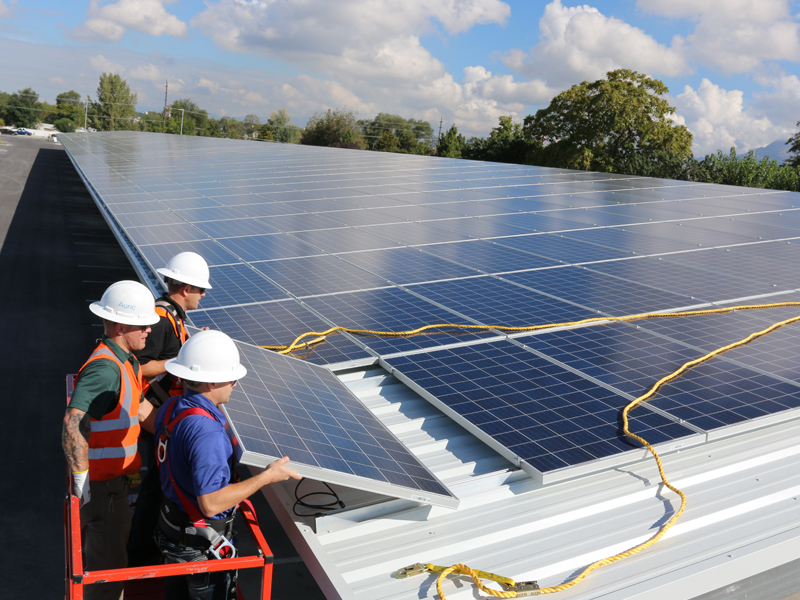
Everyone is talking about—and doing something about—sustainability. Metal roofs fit nicely into the sustainable-material equation because of their myriad traits, such as recyclability, reflectivity, longevity and durability.  Another major component in the sustainability equation is renewable energy—the production of energy from renewable resources like sun and wind.  A metal roof is the ideal location for solar energy production on homes, commercial buildings and recreational applications.

Why Solar Panels and Metal Roofs?

metal roofing and solar panels
One of the key factors for long-term success of rooftop solar energy is the quality of roof under the solar panels.  Roofs under photovoltaic (PV) systems should be durable and have an equivalent service life to the solar panels.  However, too many traditional roof systems do not have a service life that matches, let alone exceeds, the service life of the PV panels.  This is where metal roofs excel.

Service Life of Metal Roofs

A study of roof system longevity presented at the Fourth International Symposium on Roofing Technology by Carl Cash, a principle at Simpson Gumpertz & Heger, showed that metal panel roofs have the longest service life when compared to asphalt-based roofs and single ply roofs.   The study showed that the average life of metal panels is 25 years.  BUR and EPDM were second and third, respectively, at 16.6 and 14.1 years of average service life.  Exceeding the Cash study, a more recent study conducted by the Metal Construction Association (MCA) and Zinc Aluminum Coaters (ZAC) Association showed the longevity of low-slope unpainted 55% Al-Zn alloy coated steel standing seam roofing (SSR) systems is 60 years.

Service Life of Solar Panels

Solar panels will last 25 to 30 years.  In fact, some of the very first PV panels from the 1960s and 1970s are still producing energy.  While their efficiency might decrease over time, solar panels will make electricity for many decades.  For the most cost-effective rooftop solar energy installation, the longevity of the roof should be equivalent, or greater, than the solar panels so that the roof doesn’t need replacement during the life of the solar energy system.  Metal panels are the most reliable, long-term roofing system for solar energy installation projects.

Built to Last

Solar Metal Roof Panels
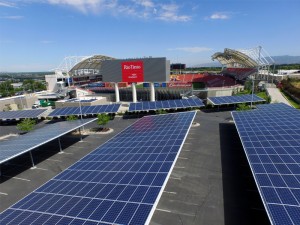
Solar Roof Panels on Real Salt Lake City Stadium

Simply put, installing solar energy on rooftops that don’t have an equivalent service life is a mistake, especially for solar projects that cover a large portion of the rooftop.  The cost of decommissioning, removing, and replacing rooftop solar energy can cost 20% to 100% of the original installed cost.  The cost tends to align with the percentage of rooftop covered with solar panels.  Much of the cost to remove and reinstall is labor, but an older solar energy system will likely need some new components—most likely new wiring—when reinstalled, also adding to the cost.

Rooftop solar installations continue to grow year over year.  And with the extension of the federal investment tax credit for five years, expect more solar energy installations on roofs.  Pair solar energy with a metal roof, and you’ve hit a sustainable “home run.”

Learn other ways to implement Net-Zero Energy strategies into your building and learn how MBCI’s products contribute.

Better Barriers: Meeting Thermal Performance and Controlling Air & Moisture

Panelized metal exteriors have joints. It’s just a rule of best-practice design. Yet these joints are seen by some as interruptions in the façade or roof, when in fact they are connections — the opposite, one can argue, of the word “interruption” that suggests a discontinuity.

Edie's CrossingIn fact, engineered metal panel systems offer arguably the best possible continuous exterior system. Not only are they properly applied exterior to the building structure—outboard of columns, joists and girts—but they are also designed to ensure an unbroken chain of thermal control and barrier protection. Combined with controlled penetration assemblies as well as windows, doors and skylights that are engineered as part of the façade and roof system, the insulated metal panel (IMP) products provide unequaled performance.
That’s the main reason that specialized facilities designed for maximum environmental barrier control are made of IMPs: refrigerated warehouses, R&D laboratories, air traffic control towers and MRI clinics, to name a few.

But any facility should benefit from the best performance possible with metal roofing and wall panels. Consider insulation shorthand for the code-mandated thermal barrier required for opaque wall areas in ASHRAE 90.1 and the International Energy Conservation Code (IECC). For a given climate zone, says Robert A. Zabcik, P.E., director of R&D with NCI Group, the project team can calculate the functional amount of insulation needed by using either the “Minimum Rated R-values” method or the “Maximum U-factor Assembly” calculation. For IMPs, teams use the Maximum U-factor Assembly, which can be tested using ASTM C1363.

With IMPs, the test shows thermal performance values up to R-8.515 and better per inch of panel thickness, meaning that a 2.5-inch-deep panel would easily meet the IECC and ASHRAE minimums.

With metal roofing panels and wall panels, a building team can achieve needed energy performance levels with this single-source enclosure, providing a continuous blanket of protection.

The same is true for air and moisture control. In a July 2015 paper by Building Science Corp., principal John Straube wrote, “Insulated metal panels can provide an exceptionally rigid, strong and air impermeable component of an air barrier system.” He noted that, “Air leakage condensation cannot occur within the body of the insulated metal panel, even if one of the metal skins is breached, because all materials are completely air impermeable and there are no voids to allow air flow.”

In terms of water control, Straube writes that IMPs have a continuous steel face that is a “high-performance, durable water control layer: water simply will not leak through steel, and cracks and holes will not form over time. The exterior location of the water barrier,” he adds, “offers some real advantages.”

Clip-Fastener-AssemblyEnfold_blog

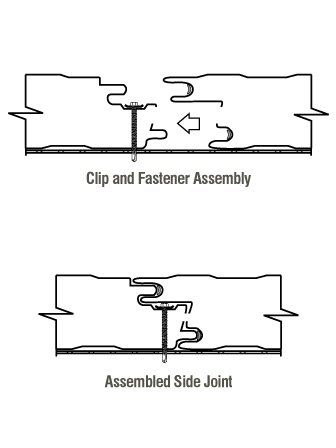
Connecting the panels at transitions, penetrations and panel joints is the key, of course. Straube notes that sealant, sheet metal, and sheet membranes are effective and commonly used to protect joints.

In my experience, these joint details are incredibly effective. They often outlast most other components of the building. Even more important, they help make IMPs better barriers that meet thermal, air and moisture performance needs. They help make metal panels one of the best choices of all.

Find a sales representative