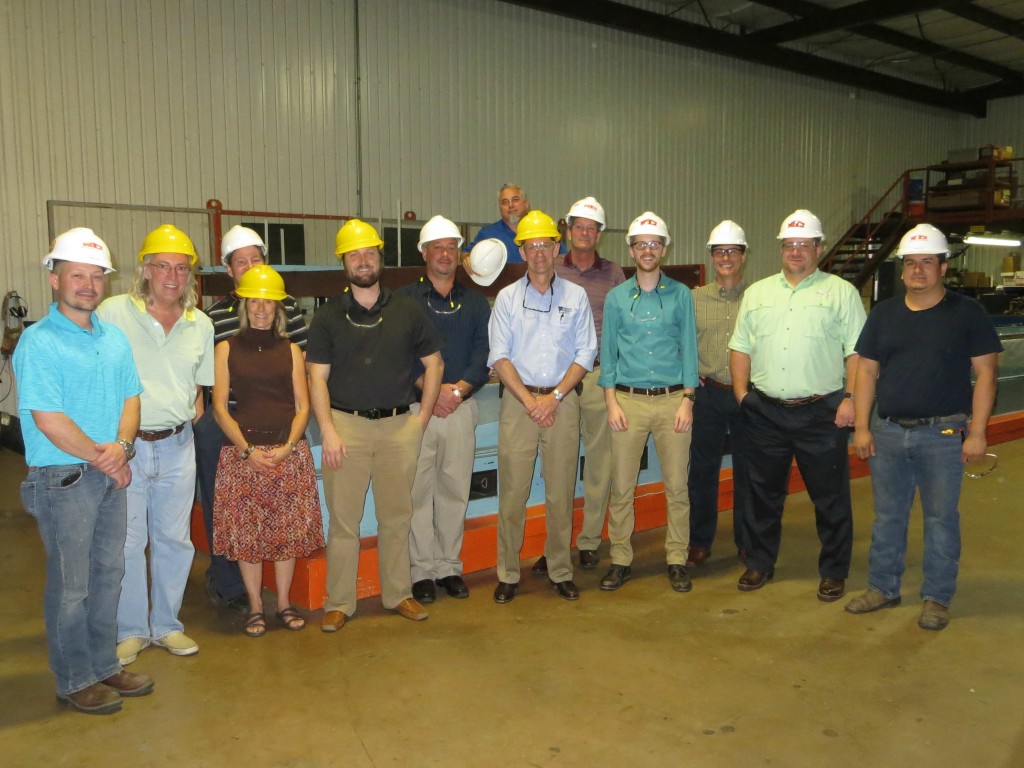
To ensure our products perform as expected, MBCI conducts a variety of tests at our onsite laboratory in Houston, Texas. On April 16, MBCI and our parent company, NCI Building Systems, welcomed several researchers from the Insurance Institute of Building and Home Safety (IBHS) to our Houston headquarters to witness ASTM E1592 testing on MBCI’s standing seam roof panel Double-Lok. This test is designed to evaluate the structural performance of a standing seam roof system under uplift loading experienced by roofs during wind events.
IBHS conducts research to improve loss prevention-related design practices and better understand the risks of insuring buildings and homes. IBHS’s facilities include a full-scale wind tunnel in South Carolina which recently tested a 30’ wide, 50’ long building by our sister company, Ceco Building Systems, using the same standing seam roof system used in the E 1592 test. IBHS’s researchers joined our testing to observe how manufacturers test their own products so they may develop design-related loss prevention strategies which can help reduce insurance costs for consumers of metal roofing.
NCI’s Senior Research and Development Engineer Mark Detwiler, who was present at the testing, said “[IBHS] indicated that the test they witnessed reinforced that the industry rigorously tests their roof systems. They also noted that the failure mode they witnessed was consistent with what they have seen in their loss investigations, meaning that the test yields realistic, predictable results.”
A huge buzzword in the building products industry these days is transparency. The green building movement, which has previously focused on high-performing buildings with a strong emphasis on energy efficiency and fossil fuel use reduction, has increasingly put its cross hairs on occupant exposure risk in the last few years. Although that change alone is probably enough to start some controversy, how this new emphasis is being implemented is really fueling the fire for new arguments. If you read our last blog, Part I – The importance of consensus in building standards, then you should be familiar with how building codes are developed in a consensus-based forum in which all affected parties have some say. However, many of the movers and shakers of the green building movement have bypassed that forum by folding the requirements they want to emphasize into voluntary programs of their own creation. At the same time, they lobby owners and building officials to carry some level of compliance to these programs, offering a benefit of being able to say their buildings or communities are “green” by displaying plaques on the façade or being listed on a website.
Although that tact seems fair on the surface, it really puts a lot of power into the hands of self-proclaimed experts to decide on the definition of “green” they want to use for their program. As we discussed in Part I, the ANSI consensus process requires policy-making organizations to transparently prove their competence in subjects they affect with their policy. Furthermore, they also have to publicly announce the formation of a committee (called a “Call for Committee”) they designate to create and maintain this policy. They must also allow members of the public to submit curricula vitae for consideration to join the committee without necessarily being a member of the organization. This introduces a mechanism to balance the power the committee is usurping by having control of the policy going forward. Unfortunately, no such mechanism exists for many of the authors of voluntary green building programs and the negative aspects of this are particularly pronounced in the area of building product transparency.
One of the most common ways green building programs administer transparency is through the use of a “red list,” which is essentially a list of banned substances. Using California Proposition 65 or Europe’s RoHS as a model, many of the NGO-based programs related to buildings have some type of requirement that aims to reduce or eliminate the use of ingredients that could possibly be harmful to building occupants. In many instances, these same NGOs offer third-party listing programs that a building manufacturer can join and have their products declared as meeting the requirements. Many people see this as a conflict of interest since an NGO, typically funded through donations, is in a position to act as a gatekeeper, allowing in only those companies or industries that support the NGO financially or align themselves with the NGO’s agenda.
But there is a deeper, more disturbing aspect: Although the list itself may start out as a publicly accepted and scientifically based enumeration of toxic ingredients, NGOs often add other substances that are not known, or in some cases, even suspected, to be toxic in order to dissuade architects from specifying certain products or deploying certain construction methods. Quite often, the NGO will develop the red list in closed discussion forums where manufacturers have no ability to provide evidence to substantiate that their products are indeed safe. At best, a manufacturer can ask the NGO to consider exceptions or modifications. But ultimately, a manufacturer has no assurance that their case has been adequately considered because they are not allowed to attend the forum. Sadly, this is what passes for transparency in green construction more often than not lately.
This lack of due process came to a head in 2013, when members of congress began to express concern that LEED, the green building program used by the military and the General Services Administration, was not an ANSI-based standard. In response, the GSA formally announced that they would take public comment on the subject and decided nine months later that they would continue to specify LEED but other ANSI-based programs would be considered going forward as well. Meanwhile, the military announced that they were developing their own standard, distancing themselves from LEED. This quelled the discussion for a while and allowed other, even hotter subjects like healthcare to take the spotlight. But concern lives on that the lack of transparency in the development of LEED and similar programs is leading the public down a dangerous, politics-as-usual road.
However, the news is not all bad. There are several organizations that use an ANSI-based process to develop and maintain their programs so that the requirements can readily be incorporated into public policy. ASHRAE, ICC, and a newcomer in the U.S., The Green Building Initiative, have all invested the tremendous amount of time and effort it takes to develop their standards in an ANSI-based public forum, and their respective programs offer a building owner or code official a great alternative to vague voluntary programs subject to interpretation by self-proclaimed experts. We will explore several of those options in our next blog.
Most people understand the purpose of a building code: To ensure the safety of the occupants and to establish the minimum accepted performance level of the building and its systems. Fewer people understand that because building codes are adopted into law by a governing body, technically referred to as an Authority Having Jurisdiction or AHJ, they are an in fact an extension of the law or ordinance that brings them into effect. Knowing that, you should not be surprised to learn that like laws, building codes in America can’t just be arbitrarily made up by somebody having the authority and know-how to do so. Instead, they must have gone through some type of consensus process in which all affected entities or their representatives have the opportunity to participate. This concept, called Due Process of Law, is central to many governmental charters such as the Magna Carta and The Constitution of the United States of America and is designed to ensure that a person’s individual rights are not unfairly taken away.
Under the US Constitution, laws are written by Congress and interpreted by judges. Members of Congress are elected by their constituents and judges are either appointed by elected officials or elected themselves. Similarly, building codes are written by consensus bodies, like the International Code Council or ICC, and interpreted by Building Officials, who are generally appointed by elected officials. The code development process used by ICC is one where any interested member of the public can participate and is guaranteed a forum to propose changes and comment on the proposed changes submitted by others using a system governed by Roberts Rules of Order. After discussion and debate, the code committee votes on the individual proposals and those that pass are incorporated into the code, guaranteeing due process. (Actually, it’s quite a bit more complicated than this but for purposes of this blog, let’s just leave it at that.)
However, building codes commonly do not actually spell out all of the requirements for buildings and building systems. More and more, the code will delegate low-level detailed requirements to a different type of document called a standard, and then brings the requirements contained within by referencing the standard in the code by name. Likewise, these standards then must also be developed through a consensus process administered by an adequate standard development body. But because all standard development bodies are structured a little differently, it is not realistic to mandate that consensus process directly. Instead, another independent body called The American National Standards Institute or ANSI, certifies standard development bodies as having a sufficient consensus processes to be deemed as meeting the incorporating code requirements for due process. Examples of these bodies are the American Society of Civil Engineers (ASCE) who develop ASCE 7, the document that determines the minimum load requirements for buildings; the American Society of Testing and Materials (ASTM) a group widely known for developing material and testing specifications for general use; and the American Society of Heating, Refrigeration and Air Conditioning Engineers (ASHRAE), who develops ASHRAE 90.1, the document that spells out the minimum building energy efficiency requirements. If you are an architect or engineer, all of these acronyms should sound very familiar to you.
Another acronym that you are probably familiar with is LEED, which stands for Leadership in Energy and Environmental Design. It is developed and maintained by the US Green Building Council (USGBC) and is the premier green building program in the world. Interestingly though, the development landscape changes drastically when it comes to green construction programs like LEED. You see, the USGBC is not an ANSI accredited standard developer and thus LEED is not an actual official standard, hence the use of the word “program”. How then is it possible that USGBC can have so much say in how buildings, particularly publicly owned buildings, get built? The answer is that they get around this limitation by structuring LEED as a voluntary program and then lobbying the potential owners of buildings, like the US and state governments, into using their program by executive order rather than legislating the requirement directly. If you’ve watched TV at all in the last year, particularly with respect to immigration reform, you know how controversial this approach can be. Nevertheless, it is perfectly legal in this context.
This really has not been a significant issue to date because LEED does have a consensus process (albeit not an ANSI accredited one) and LEED credit requirements have been fairly uncontroversial in past versions. However, LEED v4, the latest generation of the wildly popular green building program, changed all of that by adding credits that are less about design and functionality of the building and more about transparency with respect to building product ingredients to ensure occupant health and comfort. Let’s be clear: Most reasonable people, including building product manufacturers, don’t have a problem with increased transparency and want more occupant comfort and health. But it is how LEED defines “transparency” in version 4 has many people up in arms and they point to the hypocrisy of developing a definition to the word “transparency” during a closed-door meeting with no manufacturers at the table as what is wrong with green building as it exists today. My next blog will explore that concept further.
I’ve always been a huge fan of the space program (Shocked to hear that, are you?) and I remember as a kid watching the space shuttle launch and repair satellites and was always curious why everything was wrapped in shiny foil. Now, as an engineer and resident energy nerd for my company, I encounter radiant barriers often. That has closed a loop for me because it turns out the mystery foil on the satellites and equipment was indeed a radiant barrier.
Radiant barriers have been around a long time. They have been used extensively in the space program for decades and even on the Lunar Excursion Module (LEM) used to land on the moon. There are many examples of materials developed for the space program making their way into everyday life and radiant barriers are just that. Incredibly, these materials are cheap and very effective in reducing energy use in a building as well. However, they are also often misunderstood and in order to help that confusion, I recently combined the questions I get about them in a FAQ format and would like to share them with you. So, push up those taped glasses and let’s go!
1. What is a radiant barrier?
A radiant barrier is a special type of insulation that resists transmission of radiation, typically in the infrared spectrum.
2. Gee, that’s nice. Now in layperson’s terms, how do they work?
Let’s back up a little. There is a law in thermodynamics that states heat will always travel from a warmer point to a colder point. And when it does, it does do in three possible modes: Conduction, convection, and radiation. Conduction is generally applicable to solids, i.e., a handle of a metal spoon with the other end submerged in hot soup getting warm. Convection is generally applicable to gases and fluids because they can flow, transferring energy from one point to another. Hot air rising up out of a fireplace, heating the flue as it goes is an example of heat transfer by convection. Radiation is heat traveling at light speed in the form of electromagnetic radiation, mostly in the infrared spectrum for objects at Earth surface temperatures. When you put lighter fluid on a fire and it suddenly flares, you will feel a burst of heat on your face instantly, right? That’s radiation.
So if you think about this, you will come to the conclusion that all heat from the sun must get to the Earth through radiation because of the vacuum of space. That is correct and exactly why radiant barriers are so important in the protecting satellites and astronauts from the extreme temperature swings they would be subjected to otherwise. You see, space isn’t really cold because the concept of temperature kind of breaks down in a vacuum. In reality, objects in space can be either very hot or extremely cold depending on their exposure to an energy source like the sun. So when a satellite in orbit goes behind the Earth, its temperature would plummet suddenly without a radiant barrier. That’s also part of why satellites are constantly rotating, to make them warm and cool evenly and prevent premature failure on the instruments on board.
But back to Earth-bound, near-room temperature objects: Most solids are very efficient (about 90%) at converting heat to infrared radiation or vice versa in order to match the temperature of their surroundings. But there are notable exceptions, one of which being polished aluminum, which is much less efficient at converting heat to radiation and vice versa. This means that in a vacuum (i.e., no conduction or radiation can happen) a warm object coated with polished aluminum will cool slower than it would without the coating. Thus, polished aluminum is a key ingredient of a radiant barrier and thus has saved many astronaut lives.
3. I thought aluminum conducts heat readily but now you’re telling me it is a good insulator?
No, I’m saying it’s a good radiant barrier. Remember, those are different things. Radiant barriers don’t have to be very thick to work, so a common approach is to take a conventional insulation liner and coat it with a thin layer of aluminum. That layer doesn’t have any direct effect on the R-value of the insulation. Now, if you were to touch the radiant barrier with another solid, only then would you have solid-to-solid contact and conduction would be a factor. Fortunately, conductors can only transfer what is transmitted to them, so the insulation still limits the heat loss. But what matters is that the radiant barrier makes the insulation work more effectively when it is placed next to air, either against a cavity or lining a room, by impeding radiation release from the insulation into that adjacent space. Think of a baked potato wrapped in aluminum foil. It will stay hotter than an identical potato without the foil even though aluminum is a good conductor because the foil emits far less radiation than the potato skin, keeping the energy contained in the soon-to-be eaten hotter potato.
4. I’ve seen that but I’ve always called it reflective insulation.
Many people do. But that name is a bit misleading, kind of like putting a statement in a FAQ. (Really, who would do that?) A radiant barrier doesn’t reflect radiation per se; it just does a bad job absorbing it. But we can leverage that behavior to increase the effectiveness of the insulation it’s attached to just as we do with a baked potato.
5. How much does a radiant barrier increase the insulation R-value?
R-value is a measure of the resistance to heat flow through traditional insulation and isn’t really applicable to radiant barriers. While it is true that energy is energy whether it is transmitted by radiation or some other mode, the amount of energy impeded by the use of a radiant barrier depends on how it is deployed. The only way to know with much certainty how much heat it is impeding is to test or model every possible configuration and calculate a total heat transfer coefficient, or U-factor for each one. This is obviously not very practical. However, there are some references you can find on the internet that will give “effective R-values” (equal to 1/U-factor) of a radiant barrier deployed in certain common configurations. They work well as long as you read the fine print and don’t use them out of context.
6. Then how is the effectiveness of a radiant barrier measured?
Radiant barriers can have one active or low-e face and an inactive face but you can also get them with two low-e faces as well. The emittance of the low-e facer is the key number. Remember that the lower the emittance, the better the radiant barrier. The lowest emittance readily available is 0.03. But it is a continuous scale and what really matters is difference between the emittance of the radiant barrier and the other solid objects in the room with which the barrier trades radiation. In fact, any material with lower than average thermal emittance (let’s assume that to be 0.9) will function as a radiant barrier to a certain degree.
If you are using a single-sided radiant barrier, you must be careful to install it in the orientation that will give the best results for your particular climate. Generally, this will be with the low-e side facing the predominately cooler environment, be it indoors or outdoors. If you install one with two low-e sides, then you don’t need to worry about it; winter or summer, it will help you save energy
Aluminum is also commonly alloyed with zinc to make a corrosion-resistant coating called Galvalume. This coating has an emittance around 0.15, so it actually can be used as a radiant barrier as well as a durable coating for a metal roof or wall panel. MBCI makes virtually any one of its profiles in Galvalume as well as painted colors and they can help you leverage that aspect in your building.
7. How much money can radiant barriers save?
It depends. Radiant barriers don’t actually result in a significant direct change in room air temperature, because air is mostly transparent to infrared radiation. (I say mostly because naturally occurring greenhouse gasses like carbon dioxide and water vapor do absorb certain frequencies of infrared radiation causing them to warm slightly.) Instead, radiant barriers work by preventing radiation from escaping the interior environment in the winter and keeping it from intruding in the summer. This keeps the solid objects in the room closer to room temperature and they in turn reduce the heating or cooling load indirectly. Take the summer condition as an example. The radiant barrier slows the release of infrared radiation from the exterior heat coming through the insulation. This makes solid objects in the room (like humans) absorb less radiation from those surfaces. At the same time, those same solid objects are releasing their own radiation at the typical 90% efficiency. This results in a net radiation loss to those objects, cooling them even though the air temperature in the room doesn’t change much. The opposite happens in the winter by keeping the radiation released by the solid objects contained in the room. How much energy this saves is going to depend on what is in the room, what its emittance is, etc. The classic residential application of a radiant barrier is on the underside of the roof, adjacent to the attic air space. Because access is easy and radiant barriers are fairly cheap, paybacks in this scenario are usually in the 2-year range or less. That’s a solid investment from an energy-savings standpoint.
Another ideal and easily accessible place to put a double sided radiant barrier is on the inside of a roll-up door. MBCI’s door division, DBCI, can provide radiant barriers for most of their roll-up doors, aiding the energy efficiency of a conditioned warehouse as a prime example.
So, there you have it: Everything you wanted to know about radiant barriers but were afraid to ask because you didn’t want to sound like a nerd. Fortunately, some of us remain blissfully unaware of our nerdism and are happy to answer your questions.
Sometimes, being an engineer makes want to put my finger through my eye, into my brain, and swish it around. Reading and interpreting code requirements is one of those times. I’m not that old (please let me live in bliss on that one) but in my almost 25 year career as an engineer, I have seen some 75 code and standard revision cycles representing thousands of pages of text to review and interpret for laymen who are cursed with having to make a living selling building materials in this brutal marketplace.
I know the purpose of building codes and standards is to protect the public who need protection from the very real threats of hurricanes, tornadoes, earthquakes and freak snow storms. As an engineer who has taken an oath to protect the public, that responsibility is paramount to me and is one I carry with pride, I guarantee it. But the system we have set up to protect society in this regard has grown beyond a manageable state into monster status. Moreover, it is a venue filled with hundreds of hyper-sensitive, over-reacting people with individual research and commercial agendas, ballooning paper and free-running ink. In a recent personally defining moment, I stepped away from the tree trunk pushed firmly against the end of my nose and decided to gander upon the whole forest. What I saw concerns me because of the responsibility I have to protect the public. You see, I’m beginning to believe that the biggest threat to human life in a building is not the possibility of natural disasters but instead the threat of simple human error that increases in probability every time we plant a tree in our precious forest of public duty by introducing a code or standard change proposal. The requirements in these documents are long and complex already and getting them applied correctly to a project in a reasonable amount of time while battling the constant barrage of phone calls, texts, and emails a feat worthy of the likes of Albert Einstein and Carl Fredrich Gauss. (If you’ve never heard of Gauss, I suggest you Google him. He was one of the greatest minds of all time.) It has been called by those who have ventured down this thought path before me as the “Fuzz Factor” and I believe it to be a very real threat to public safety in today’s engineering world.
Let’s start by looking where the rubber meets the road. In 1960, the AISI cold-formed steel specification had 22 pages of requirements. In 2007, it had 114. The latest edition, 2012, has 150 pages. That’s a 680% increase in 52 years. Congratulations, AISI. You have the smallest growth rate of all the standards I track at a little under two pages a year. Hey, stop laughing at your thin-walled brother, AISC design specification because you should be ashamed. In 1941, you had 19 pages of requirements. Twenty years later, you had 57 pages. Ten years after that, 157 pages. In the most recent edition, 2010, you’ve ballooned to 239 pages. That’s about 3 pages per year not including the seismic provisions. That little piece of work did not exist until 1992 at 59 pages and is now a fat 335 pages in length. Growth rate: a whopping 15 pages per year. That’s something akin to sumo wrestlers in training. It is no better on the load side of the equation, either. ASCE 7, the standard that establishes the load levels to be expected from environmental phenomena like snow, wind, earthquakes, etc., was 92 pages in the 1988 edition. The latest edition, released in 2010 is a sporty 368 pages. That’s a growth rate of 15 pages per year as well.
Now, let’s look where pencil meets paper. Ultimately, the problem manifests in the fact that people reading and applying the code provisions are human beings with all of the limitations bestowed upon us by our creator(s) or evolution, however you choose to view that. The question is: Have human minds grown in requisite ability to read and understand all of this information? Being that Gauss died in 1855 and there has not been another mathematician like him since then, I’d answer that question with a strong “no” and I’m not alone in that. There are quite a few educational psychologists who buy into the theory that we are actually getting less intelligent as time goes on, even though we are much better educated as a society, because education tends to stifle creative thought at an early age and that skill is not developed.
So, how do we address this trend of growing complexity and shrinking time? In my opinion, the answer is relatively simple. Instead of continuing to further define the problems and solutions like we’ve done so well in the last century, we need to consider evolving the engineering process to match the complexity level thrust upon the practitioners. Buildings don’t fail if the diaphragm resistance was wrong in the second significant digit because there was no torsion considered or because a column had second order effect that magnified its load by an unexpected 10%. Instead, they fail because the resistance was overstated or the load understated on a global level by 50% or more because that’s the level of conservancy in the code typically. Case in point: The 1983 Kansas City Hyatt disaster. The initial design by the engineer was a good one and likely would not have failed. It was a later revision to that design, one that gave it less than half of the capacity of the original, that ultimately caused the disaster. The proposed change came to the engineer at a time that they were busy working on something else and was not given proper consideration. A simple human error that any of us, no matter how smart we might be, are capable of.
To me, today’s environment is one where “can’t see the forest for the trees” problems flourish. Fortunately, those problems are fairly easily spotted when put in front of a person who is capable of seeing the forest because they don’t have an in-depth knowledge of the trees growing in it. In this case, that could be a peer engineer performing a simple cursory review. To make this fully effective, it should not just be one or two peers. It should be more like 5 or 10 people with widely varied experiences and preferably strong cultural diversity, each one spending an hour or so scanning the results of the design, rather than the design itself. Diversity is more important than you might think because each of us brings to the table a unique set of skills but at the same time, we are all limited to our experiences. It’s the old adage that the oncologist will tend to suspect cancer and the dietitian will tend to cite nutritional problems with the same patient. So, let’s do what doctors do in this situation: Swallow our pride and ask for a consult from a practitioner whose experiences are different from our own. It’s simple, easy, and could save lives, let alone all of the trees consumed by the printing of fat building codes and standards.
Five years ago, I remember people talking all about Building Information Modeling, or BIM, and how it was going to change the construction industry forever. Furthermore, if you were a building product manufacturer and didn’t have an established presence in in the BIM space, your products were going to become obsolete overnight. Shortly afterwards, a giant Alaskan Bull Worm (Yes, I just dropped a Spongebob Squarepants reference on you) was going to devour your manufacturing facility, destroy your employees’ neighborhoods, and you would spend the rest of your days huddled under a bridge and eating food you grow in a ditch.
Well, here we are five years later and I’m looking around and see nothing of the sort. Yes, BIM is a powerful tool and is used on many high-profile projects. Yes, it is very helpful to architects, engineers, and general contractors. Yes, it gives building product manufacturers a new marketing medium. But at the same time, it seems like only a very small percentage of most building product manufacturer’s bread-and-butter work is chained to having BIM content. So what happened? Well, I’ve asked some architects and general contractors who are trusted advisers of mine that question and the answers I received are very interesting and sparked me to write this blog. I’m going to warn you now that this blog is purely my opinion and I’m going to float some theories that are more gut feel than researched fact. If you don’t agree with me, I welcome your opinion and would love to hear from you. I’m a big believer in the concept of a healthy disagreement, so don’t be shy.
First, let me answer the question that is the title of this blog. No, I don’t think it has lived up to the hype. That alone may spark a debate. But to me, it has not and there are a few reasons I think why not:
BIM was over-hyped in the first place – Badly, as in worse than Water World. (Poor Kevin Costner will never live that down, will he?) I work a lot of trade shows in this industry and every one I’ve been to in the last five years had multiple BIM demos from a software company. In between demos, people worked the floor visiting all of the other attendees trying to convince them that they needed to develop BIM content or they were going to go the way of the Dodo, Betamax and cassette tapes. I bought into it and led an effort in my company to get in the BIM space. That process taught me a lot and I’m glad I did it. But in that process, I realized that the software company seemed to benefit a little more from the effort than we did. After all, I was developing content for their software and then paying them to host it for me. Look, hitching your wagon to successful products with a good reputation is smart business, so I’m not saying they did anything wrong. But I do think some of the software suppliers played the fear card to product manufacturers, who admittedly are an excitable bunch, to get that to happen.
BIM Content is not locked down – Anyone can download BIM content from someone else and change it to their heart’s content and the original author will never know. That’s a good thing and I’m NOT saying that BIM content should be locked down. But you can’t put too much work into your content as a manufacturer without quickly realizing that all a competitor has to do is download a copy, change your name to his and he is in the same position you are with less than 1% of the effort. At the same time, to not openly distribute your content for that reason is not really a good idea because there are real marketing advantages to treating it like a business card. However, that advantage is over once the content is in the hands of your competitor and I believe that is a huge reason why many manufacturers have been resistant to make anything but a just a basic, almost token, effort to be a BIM player. Along similar lines, many architects and engineers view digital copies of their work as intellectual assets and (rightfully so) aren’t real wild about turning their models over to the digital space for that reason. At least when it is in print, somebody still has to convert it to digital form.
Liability Concerns– The core benefit to BIM is the ability to have a virtual building. That’s huge. It means you can know exactly where everything goes, what it will look like, how much space it will need, how it will move, etc. That takes a lot of uncertainty out major questions like how long will it take to build this building? How much will it cost? Will it function as intended? Obviously that’s not just a good thing, it’s a great thing and in theory would reduce liability tremendously. But that’s IF everything is modeled right…scratch that…perfectly, and that is never going to be the case because the people using the tool are humans. Many architects, engineers and general contractors I’ve talked to are deeply concerned that the amount of time it takes to get everything nailed down to the gnat’s you-know-what will result in an increase in time (and thus fees) that the market simply will not bear. However, that is the owner’s expectation now because the software does have that ability. That perception-reality gap results in an increased liability on engineers, architects and especially the general contractor. If an unexpected problem happens, the owner is there saying, “You had a BIM model, you should have seen this coming.” This just in: General contractors get sued… a lot.
Let’s be very clear here: I’m a BIM proponent. I think it is a good thing and will change the construction industry significantly over time. Just not as much as everybody is saying nor as quickly as they are saying it will change. Of all of those reasons, I think the last reason is the most significant and it actually has nothing to do with BIM; it is really a people issue. To me that says that it is not actually the shortcomings of BIM holding BIM back but instead well-meaning people who might be trying to use BIM out of its natural context.
Here is the point of this blog: BIM could live up to its hype if it is utilized in a way that addresses the liability issue and provided the entity responsible for the model a direct benefit to having a near-perfect virtual building, which is undoubtedly the strength of BIM. When does that happen? The Design-Build contract, that’s when. In this case, the architect is working for the general contractor, who benefits highly from having the model because of the ability to do clash detection and construction phase modeling, just to name two. With that motivation, he is more than willing to pay the architect and engineer the extra money to do the modeling down to the gnat’s you-know-what. It’s truly is a win-win.
Say what you will about BIM. At the end of the day, it is not BIM that is in control of our industry, it’s us. If we all work together to create a favorable playing field to let disruptive technologies take hold, they will. If we don’t, they won’t and our great grandchildren will be building their buildings just like we did while everyone rides around in flying zero-carbon cars that did live up to their hype.
Being a building scientist is kind of like being a librarian. You have to separate fact from fiction. Case in point: The Green Building Movement. I’ve been a building designer for 20 years and I have never seen the kind of change and repositioning of building science in the time that I’ve seen in just the last five years. And of course, with that come agendas, minutia, politics and confusion. It’s unavoidable. So, when people ask me about green building, I feel the duty to encourage them to stick to what is tangible and measurable and try to stay out of speculation. Yeah, ok, that’s pretty obvious advice. But it cuts deeper than that because you actually have to track meaningful, FACT-BASED metrics.
Consider the regional material credit in LEED. The purpose of that credit is to avoid burning fuel to transport raw materials to the project site. So, if the final manufacturing location of a product is within a 500 mile radius of the project and you can prove that the material used in the product was extracted and/or harvested from the earth within that circle as well, you get credit for using it. But does that truly guarantee the minimum carbon footprint? Most products used in buildings have been through a long and complex supply chain of co-mingling and transportation between intermediate points and the simplistic criterion of only considering the end points of that chain isn’t going to guarantee any level of performance, so why track the metric?
At the other end of that spectrum is energy use. This is NOT the same as energy efficiency, mind you. The definition of efficiency is the amount of work done divided by the amount of resources consumed to achieve that work. If my efficiency is 1, then I’ve wasted nothing. If it’s zero, I’ve wasted everything. It seems like a good metric to use, but it isn’t always obvious what number to use in the numerator (that’s the top number in a fraction, by the way) which makes efficiency somewhat subjective as a metric.
Electricity use on the other hand, is an absolute metric. You use electricity and have to pay for it. You have a meter to tell you how much you’ve bought. That’s a pretty convenient thing because you don’t need a fancy computer with wireless controls and bells and whistles (which use electricity, by the way) to print a graph of your electricity usage. All you have to do is get up off your derriere and look at it. (Yes, it is unfortunate that meters are outside but you need the sun exposure to produce Vitamin D anyway.)
So when it comes to things like roof top solar, the subject of my last blog, the energy you make directly offsets the energy you use. The meter “spins” slower or even backwards (net-metered solar installations use digital meters, but whatever) and at the end of the month, less electricity is used. Simple, predictable and efficient; there is no question what your impact is.
Now when it comes to energy used for climate control, you are in a quandary. The energy you use is going to be highly dependent on the outside conditions, so how do you account for that? Well, the fact of the matter is that weather, although it varies quite a bit from day to day and year to year, follows a very consistent pattern over time and some things you can do will always make a difference.
Most commercial buildings are under insulated. We know that from studies conducted over many years by the government. The reason is simple: Commercial buildings are not usually built by the electricity bill payer, so the motivation to invest in things like extra insulation and insulated windows is not there. Therefore, if you should inherit a commercial building for your business, before you move in, you should probably peel back those ceiling tiles and tap on that glass to see what is between you and the outside world.
Should you discover that you need a little extra help, there are some great products on the market these days and one of them is spray-foam insulation. However, if the building is old enough and needs a new exterior finish on the roof or wall anyway, consider an all-in-one solution like an insulated metal panel. This product combines one of the most durable exterior materials around – coated steel – and the same great insulation performance as the spray-on foams without the special equipment. Plus, the excellent air barrier performance minimizes air infiltration. And here is a tip: Roof or wall, choose an exterior color that fits your climate. Consider using lighter colors in the south and darker colors in the north. That can make a substantial difference if the building is under insulated. The poor meter won’t even know what hit it.
As an engineer who works for a metal roofing company that also sells roof-mounted photovoltaic (PV) equipment, I have the incredible opportunity to help people turn their metal roofs into money making machines. That’s more literal than you think, especially if you have good incentive programs available to you or your electricity costs are high or varying over the course of the day. I’ll leave the environmental green reasons for another blog. I’m talking cold, hard cash here, folks. I’ll be very honest: A PV system is a sizable investment. But they can also have rates of return associated with them that make day-traders salivate.
However, I do find that the vast majority of my time is spent educating potential owners of PV systems on how these systems operate and how that translates into cash flow. Along the way, I have discovered many misconceptions that very smart people have about PV. I have listed them below and this is my attempt to put some of those things to rest. Are you ready? Let’s power on.
1) I have to put holes in my roof to support a PV system
Call me old school if you want, but from where I come, putting a hole in your roof is a bad thing. Fortunately, if you are blessed with a metal standing seam roof, there is a very good chance you can mount a PV system on it with ZERO roof penetrations. Zero, zip, nada, or as the soccer folks say, nil. There are some very good mechanical mounting systems out there and many of them do not require expensive aluminum railing because they attach directly to the roof seam. That’s a huge cost savings but in my opinion, the risk it mitigates is even more important. I may sound like Captain Obvious when I say this, but every time you penetrate a roof, you increase its chances of leaking in the future. This just in: Roof leaks are bad.
2) I need a battery system to work with my PV system
I run into this misconception every day. Unless your building is in a place where your electricity service is questionable or non-existent, batteries are not required or even advisable. Why? They are expensive, maintenance intensive and a power drain. Case-in-point: Your cell phone battery. Granted, they are typically different technologies than PV system batteries but the situation is very similar. If you’ve ever priced them, you know they are expensive. If you’ve ever had one that wouldn’t charge all the way because you haven’t been draining it all the way, you know they are maintenance intensive. And if you ever felt one get very hot as it charged that last 10% or while you were using your GPS, you know they waste power. (That heat energy has to come from somewhere, right?) They also only have about half the life expectancy as a PV system. By contrast, the electrical grid is like the world’s most perfect battery. It costs you nothing (I mean the grid itself, you obviously pay for it indirectly when you buy the electricity), it basically lasts forever and someone else is responsible for maintaining it and fixing it when it does break. But most importantly, when you put power into the grid, you get 100% price credit for that electricity, provided your utility supports net-metering. It’s really a no-brainer.
3) PV Systems only make electricity during the day
OK, this is not a misconception; it’s true. But so what? You don’t use electricity during the day? Your building probably uses more electricity during the day than any other time. And even if that’s not true, if you are a net-producer of electricity and your utility supports net metering, your meter simply runs backwards during this time, offsetting the cost incurred when you are using electricity. All of this with no battery involved. It’s why there are more grid-tied systems being installed now than battery systems and that trend is not likely to change. Furthermore, if you live in California or other places where your electricity rate is higher during the day than it is off-peak, PV systems can really have a huge impact on your bottom line because they are producing the most when demand is the highest.
4) My roof doesn’t face south, so it’s not worthwhile to put PV on it
Au contraire, roof azimuth has less effect than you might think and it is certainly secondary to what your incentive and electricity cost situations are. I won’t go into a deep technical explanation here, but I’ve learned one thing after years of running payback calculations on PV systems: If the money is right, the building is right. You may not have the absolute lowest payback or highest ROI theoretically possible, but the cash flow will still be very favorable. Also, don’t fall into the same thought process because you’ve heard that that the PV modules have to slope the same angle as your latitude. Oh look, that’s our next misconception!
5) My roof doesn’t slope enough to hold a PV system
While it is true that PV systems theoretically produce more electricity when they are pitched at an angle equal to your latitude, much like azimuth, this effect is far less than you think. Obviously, it’s not advisable to mount a PV system on the northern slope of a 12:12 (45 degree) roof. But like most things in life, PV electricity production operates on a sliding scale and the end result is a function of many factors working together. If you focus too much on any single factor, you’re missing the point. (To refresh, the point is to put money in your pocket.) And, THIS IS IMPORTANT, there are other more serious issues with racking and tilting systems that you have to contend with. Keep reading, this is getting serious.
6) I need to have a rack system on my roof to support the PV
Not true. PV systems work very well on flat or near flat surfaces. Besides, if you live in certain parts of the country where heavy snow or high winds are a concern, I’d highly advise you to stay away from rack systems. Think about this: What does a rack system look like to you? Spanish Armada-era sailboats sitting in a harbor, perhaps? Do you REALLY want an air foil on your roof if you live within reach of a hurricane? I’m guessing not. Perhaps even more dangerous is the potential snow accumulation that can happen under a rack-mounted PV system in snow country. This is a situation we engineers call aerodynamic shade and it is a serious concern from a structural standpoint. After alternating heavy snows and freeze-thaw cycles, hundreds of pounds per square foot of snow can gather under and around a roof obstruction and I doubt your building was designed for that. I highly encourage you to call your structural engineer and have this discussion with him or her before you put a rack-mounted PV on your roof. I’m being very serious here; the consequences are severe or even life-threatening.
So, there you have it. There are many more aspects of PV than I can cover in this forum but hopefully, this charges your brain and sheds some light on a subject that is just starting to heat up. Since I’ve obviously blown my pun quota, I’ll have to cut it here. But if you want more information, please visit www.mbci.com/solar.