Nice Curves! Stunning Architecture with Curved Roofing and Walls

Breaking away from simpler panels, more and more architects are experimenting with arched and curved metal roofing and wall panels to upgrade their designs. This enables designers to incorporate exciting elements like concave and convex curving, not as feasible with other cladding materials.

Combined with unique angles, increased edge finishing options, appealing gutter options and greater compatibility with shingle types, architects now have access to a greater assortment of mix-and-match options.

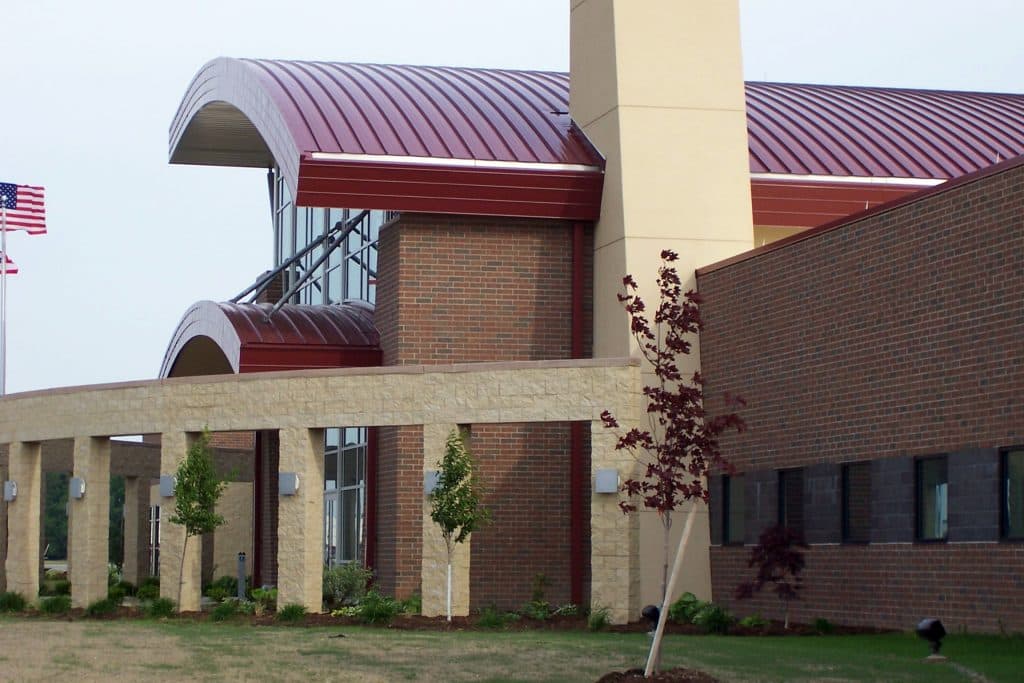
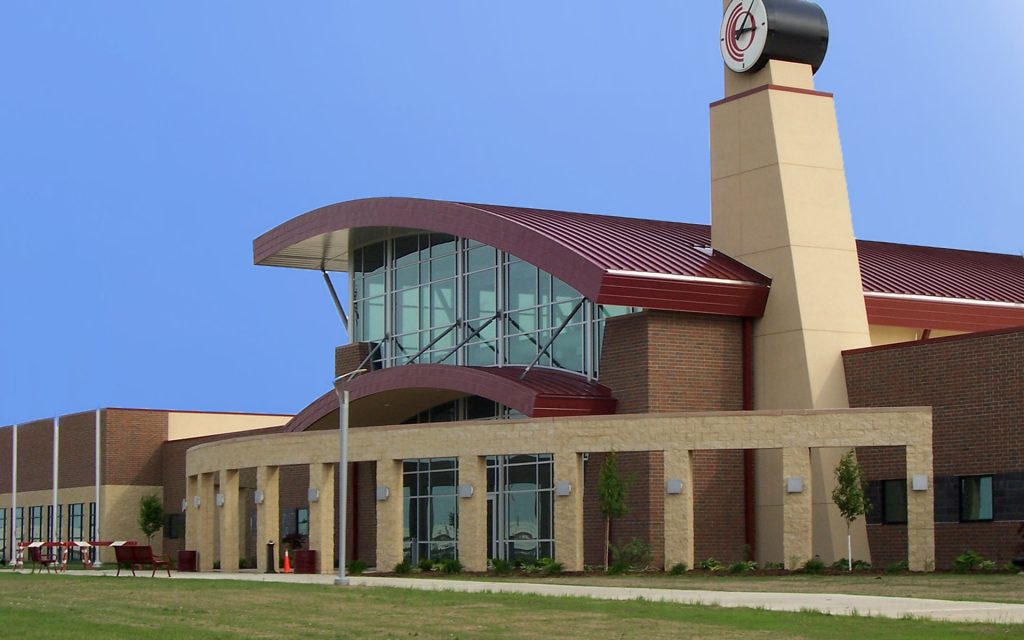
For example, at Owens Community College in Findlay, Ohio, a regal red, double-curved canopy crowns the curtainwall with 15,500 square feet of 22-gauge curved metal roof panels. Designed by Rooney Clinger Murray Architects, the structural roofing panel system, fabricated by MBCI, is ASTM tested for air infiltration and water penetration, and incorporates a 2-inch tall standing seam that was field seamed during the installation process. The contractor, Charles Construction Services, won the American General Contractors (AGC) Build Ohio Award for “New Construction Under $10 Million.”
Owens Community College
For Owens Community College, the Curved BattenLok® metal panels in red accentuate the arch of the campus, making it the focal point of the building.

Another noteworthy curved design example is the Central Los Angeles Area High School #9, designed by HMC Architects. “Metal enabled us to clad buildings of different geometries, including curved geometries, in one material, while also giving them a special appearance,” reported Kerstin Kohl, spokesperson for the project’s design architect, COOP HIMMELB(L)AU, in a Metal Construction Association case study, Steeling Art for Students.

Using CAD and BIM for Curved Metal Panels

For designing and fine-tuning curved metal creations, the latest CAD and BIM features are key tools for architects.

In creating the “geometry that has been freed from the relentlessness of the orthogonal layout,” as described by Mark Dewalt, AIA, principal at Valerio Dewalt Train, in a recent article in Metal Architecture magazine, New Trends in Metal Architecture, designers are using CAD in shop drawings to support unique façade fabrication.

“The use of computer design to warp and twist and perforate will give metal greater longevity, added Kevin Marshall, AIA, LEED AP BD+C, associate architect, Integrated Design Solutions.

Similarly, BIM software is further supporting enhanced compatibility with metal roof and wall designs with newer features such as automated light gauge steel wall framing work and the ability to more easily configure supporting structures, openings, complex L or T connections and service hole positions while providing photorealistic renderings so that the client can see exactly how their building will look once built.
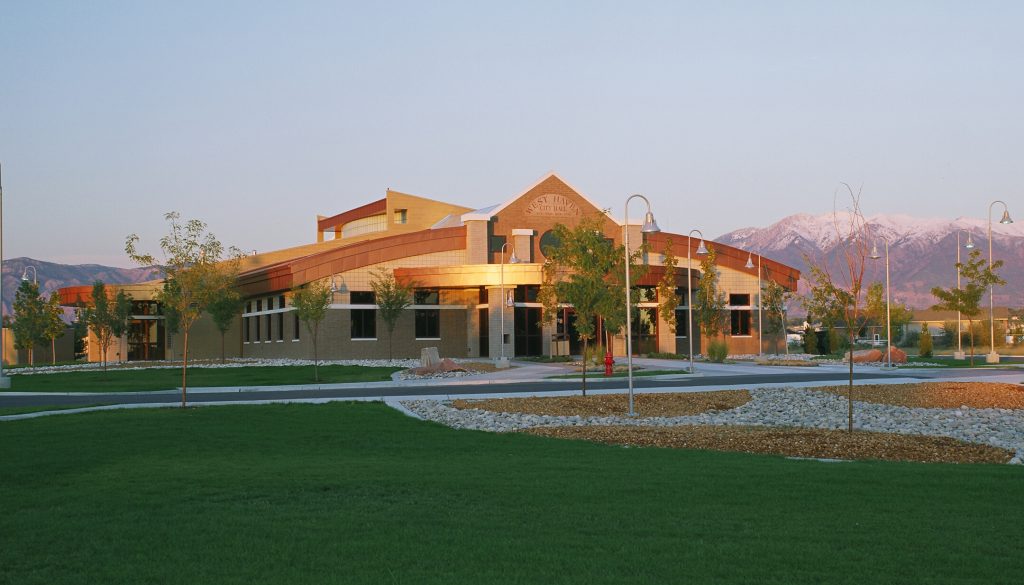
West Haven City Hall
West Haven City Hall combines MBCI’s Curved BattenLok® in Copper Metallic with Artisan® Series and Flat Sheet.

Ensuring a Tight Building Enclosure with Curves

As with any roofing type, designing and installing a tight building enclosure for curved roofing and walls is essential for delivering a high performing building.

For starters, architects must choose an appropriate vapor retarder, especially in cooler climates and interior relative humidity levels of 45 percent or greater. Also, buildings with high humidity interiors and construction elements that may release moisture after the roof is installed–such as interior concrete and masonry, plaster finishes and fuel-burning heater– require special considerations when choosing vapor retarders.

With utility clips, some curved panels will lay tight to the wood deck, but if tin tabs are used to attach the moisture barrier to the wood deck, then they will need to be covered to prevent the tabs from rusting the back side of the panels. Similarly, plastic washers may not be the best option as they run the risk of impacting the panels, resulting in undesired aesthetics. Rather, peel and stick membranes are a preferred underlayment because they eliminate the potential of underlayment fasteners penetrating or dimpling the panels.

A Savvy Look for Design

Whether it’s wavy, circular or some other exciting soft geometric shape, curved metal roofing and walls open up all kinds of new design possibilities. Out of the box, literally, architects are actively producing exciting, eye-catching creations with these welcomed capabilities.
Calculating Cool Roof Energy Savings

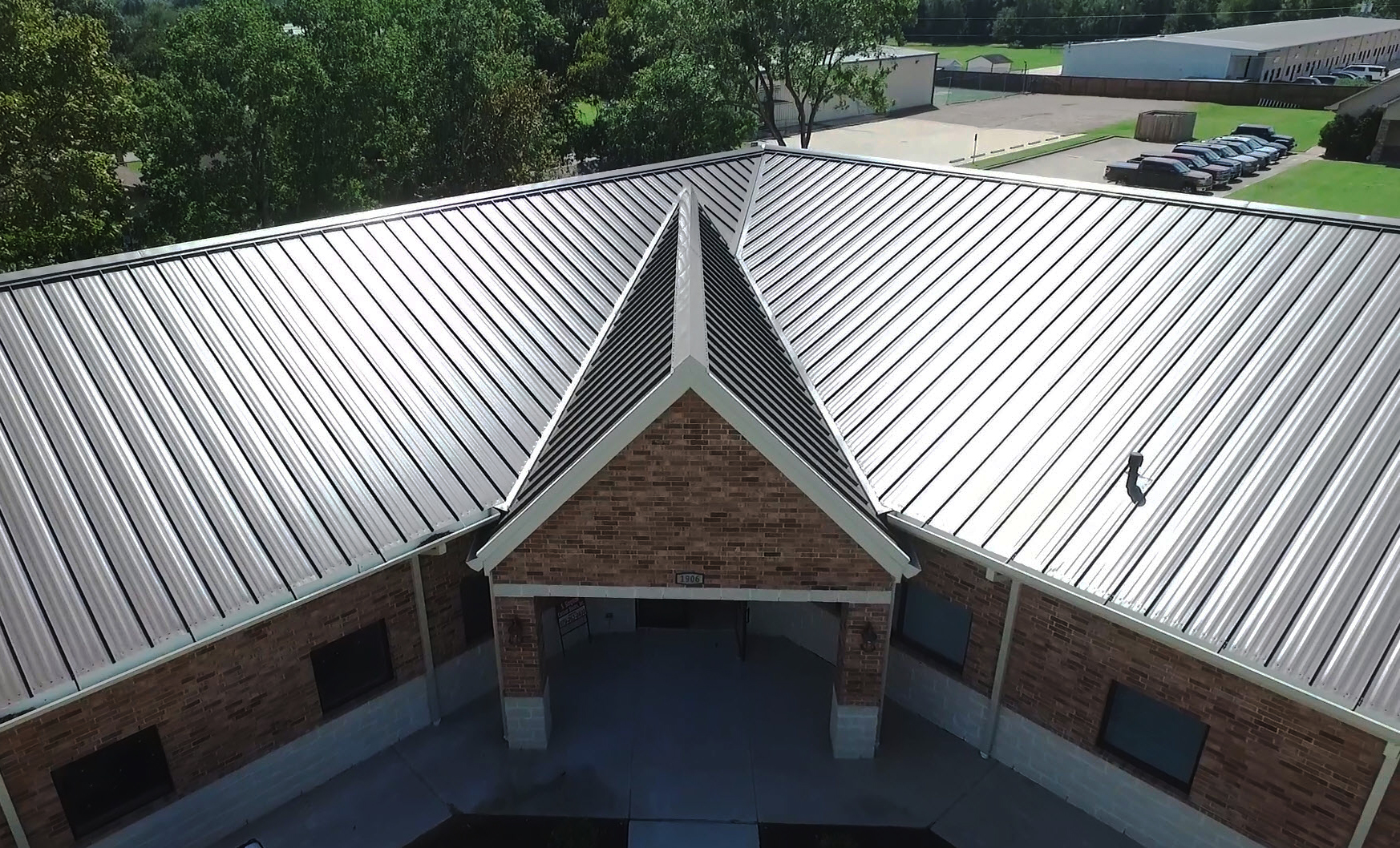
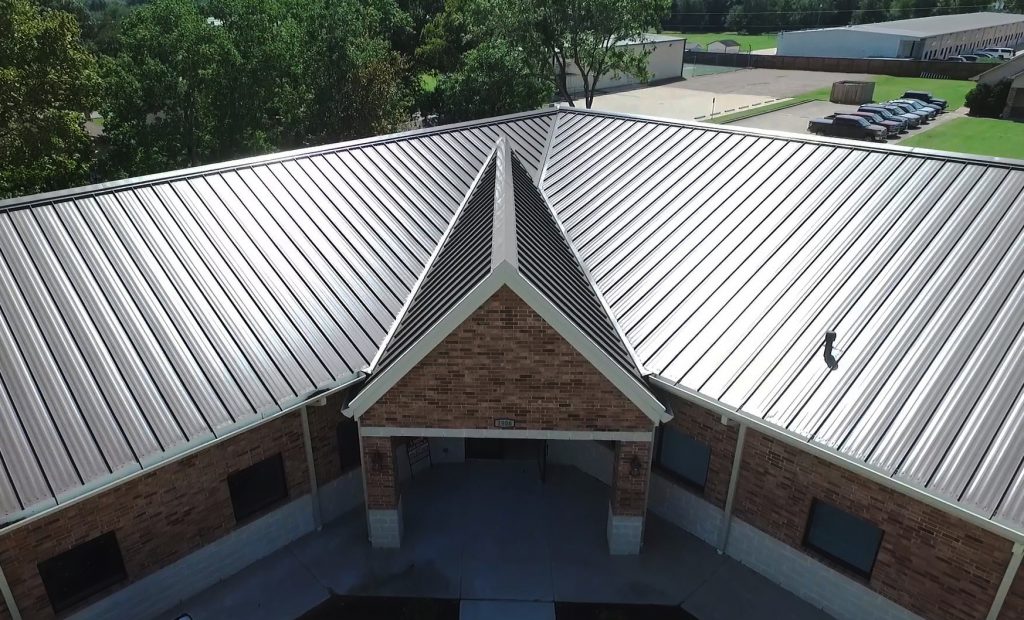
Whether it’s providing waterproofing, reducing thermal expansion and contraction, or supplying chemical and damage protection, cool metal roofing has much to offer. Of course, the most substantial benefit is the energy savings gleaned from reduced rooftop heat levels driving down air conditioning loads. In fact, the Lawrence Berkeley National Laboratory’s heat island group projects a whopping $1 billion reduction in cooling costs if cool roofs were to be implemented on a nationwide basis.

To assist architects in determining the kinds of energy savings that can be expected from cool metal roofing, the Oak Ridge National Laboratory (ORNL) has parlayed the data it gathered from a three-year evaluation of metal roofing products into a whole building energy savings calculator.

Cool metal roofs are offered in a variety of colors.
In addition to energy efficiency, cool metal roofs are known for extended durability and longevity.

Cool Roof Calculator

This calculator is called, simply enough, the Cool Roof Calculator. The easy-to-use tool is described as a quick way to compare overall energy costs and savings for a variety of roof and building conditions. Unlike some energy modeling calculators, which are limited to steep slope residential roofs with attics, ORNL’s tool models the typical low slope commercial roof with insulation placed directly over the deck and under the roofing membrane.

To calculate approximate energy savings offered by a cool metal roof, architects are instructed to input the building’s location, proposed roof R-value, roof reflectance and emittance, base energy costs, equipment efficiencies, electrical demand charges and duration.

While experts suggest that it may be difficult to accurately predict the base use and peak demand without detailed construction and cost information, tools such as the ORNL’s cool roof calculator can be a useful way to gather helpful performance estimations for a variety of building types and locations.

Attempting to do just that, the calculator outputs a number of values to offer an approximate estimate of potential energy savings, broken down into cooling energy savings—a calculation of air conditioning savings from base use and peak demand reductions—and cooling season demand savings, an estimate of the peak demand charge reduction enabled by enhanced roof reflectivity.

Accessible at http://rsc.ornl.gov, users can also compare the energy performance offered by a cool roof vs. a conventional black roof.

“It’s a nice tool to give people a feel for where a cool roof would actually help them and have the greatest impact in terms of energy use,” relates Robert A. Zabcik, PE, LEED AP BD+C, director, research and development, NCI Group Inc., Houston, in a Metal Construction News article.

Roof Reflectance Baseline

Roof reflectance and emittance, requirements and options, can be found in energy codes such as IECC, ASHRAE 90.1, California Title 24, and other local codes. Requirements may vary based on roof slope and climate zone, and may allow for either aged or initial solar reflectance, thermal emittance and/or SRI.

Fortunately, MBCI continues to stay current with individual testing and also maintains third-party tested and verified product listings through entities such as the Cool Roof Rating Council, and the U.S. EPA’s ENERGY STAR®.

Design and Color Trends in New Metal Construction

Design and color trends in metal roofing products are not exactly black and white. In fact, a whole host of options are available when choosing textures and colors for new metal construction projects, depending on specific criteria. Some are practical, some are aesthetic—but all are shaping how designers are specifying metal products, coatings and paints. Let’s walk through a few of the top trends in the industry now.

More color options for coil coatings

Bright Color Options in Coil for Design
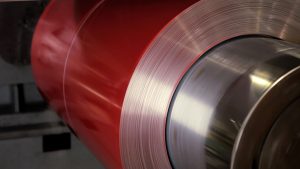
Through vertical integration, manufacturers are offering more color options than ever.

It used to be that coil options were limited to standard stock choices and availability was determined by the coil coaters. Now, with evolving industry strategies, such as NCI’s vertical integration, many more manufacturers are properly positioned to enter into the market with multiple color choices across multiple brands without as much deviation. This also allows manufacturers to quickly adapt to requests for custom colors—both internally or externally.

Ratings and regulations are leading to more energy-efficient choices

Moreover, color requests based on aesthetics and paint systems have evolved based on changing code requirements. For additional benefits, specifiers can turn to many rating systems, such as the Cool Roof Rating Council and ENERGY STAR®, as well as earn LEED points by having specific SRI (Solar Reflectance Index) values.

Much has changed over the past 10 to 15 years. For instance, the components industry has evolved from customers merely selecting colors based on preference to a more integrated approach accounting for aesthetics, cost and energy efficiency. Today, owners and architects are more likely to consider a color such as Solar White to save on insurance or receive tax rebates. Environmental considerations and regulations have changed the way customers purchase steel, incorporating such issues as unique regulations for different states and weather conditions, LEED points and reflectivity into the atmosphere.

Insulated metal panels used in higher-end architectural projects

Another design trend in the industry is a move towards insulated panels, mimicking what is typical in the aluminum composite material (ACM) world. High-end car dealerships are known for design with ACM. This includes blocked-off designs that can be elongated, can be different colors or have joints in different places. This application has been ACM’s primary wheelhouse for decades. Now that ACM manufacturers have entered into the insulated metal panel (IMP)  industry, more of the design community is considering a thinner, horizontal IMP. The intention is to replicate the appearance of an ACM panel, while reaping the major cost and insulating benefits of IMPs.

Depth of color and texture: the rise of metallic colors

Architecturally, more metallic paints are being used. Historically, metal panels were white, tan or Galvalume. The current trend has expanded to a wider color palette, including mica fluoropolymer. These metallic coatings give depth to the color, adding sheen and sparkle. In fact, there are actually metal flecks in the paint. Metal oxide-coated mica pigments offer up the metallic look and add to the durability.

 Signature® 300 Silver Metallic Color Design
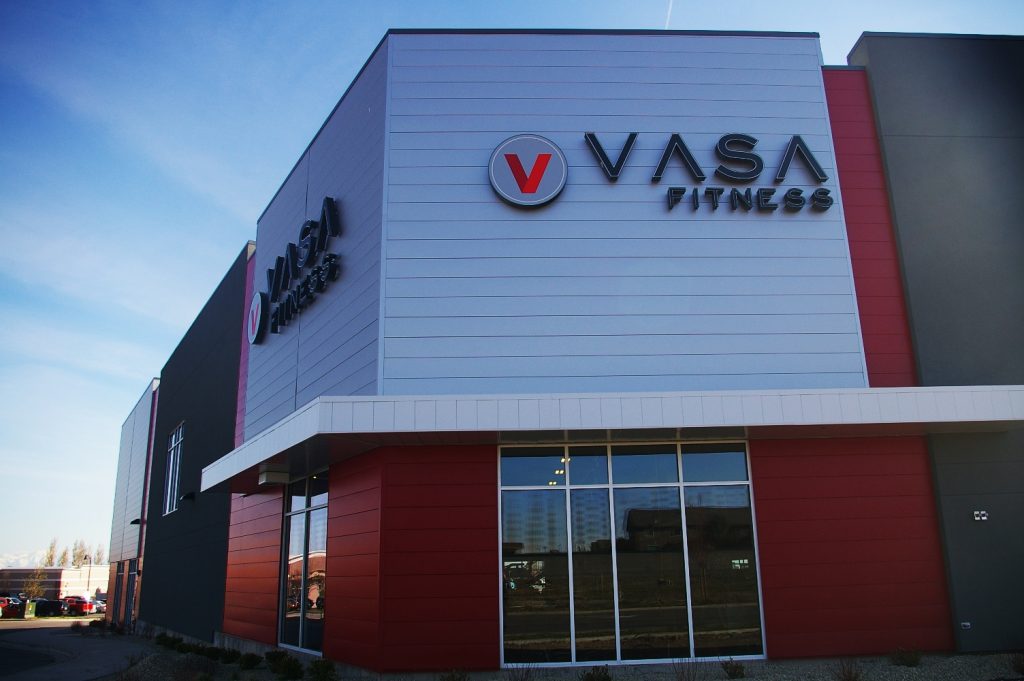
Vasa Fitness in Lehi, Utah features MBCI’s FW-120 panel in Signature® 300 Silver Metallic paint.

What’s behind this trend? Designers are thinking about metal roofs in a whole new way. They are looking to leverage colors and properties of paint to bring out a unique architectural appearance not previously available.

Conclusion

Trends in metal construction are as broad as the choices of color and coatings. Whether a reaction to energy savings criteria or simply a desire of an educated consumer to bring new life to their project, it’s worth taking the time to investigate all your options when specifying your next metal project.

Find a sales representative