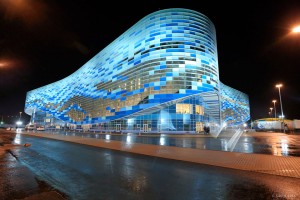
Gold Medal for Metal Stadiums

We’re a little less than two weeks away from the 2014 Winter Olympic Games, and I must admit, I’ve caught a bit of Olympic fever. I’m getting updates on my phone, I’ve got my DVR set to record my favorite events, and I have a countdown to the opening ceremony running on my desktop. (As of this post, we have 10 days, 1 hour, 39 minutes, and 40 seconds to go!)

Sochi Stadium, courtesy of Olympic.org

Aside from the Olympic events and the incredible athletic prowess displayed by the competitors, one of my favorite parts of the Olympics is the stadium, or stadiums, since the Games usually require multiple. Most host cities end up building additional stadiums and venues, and they have yet to disappoint. They’re always beautiful architectural achievements, works of art really. From the first Olympics in Athens to Games within the last decade, the stadiums steal the show, for me anyway.

We’ve got our share of beautiful Olympic stadiums here in the States, too. The Weber County Ice Sheet in Ogden, Utah was constructed for the 2002 Salt Lake City Winter Games. It served as a venue for curling matches, and since Ogden is only about half an hour outside Salt Lake City, it was an effective answer to the question of stadium space. The Ice Sheet continues to be an immense asset to the town of Ogden and has even had a Sports Complex added to it, serving as an athletic facility for both Weber County and the local college, Weber State University.

The Weber County Sports Complex
Ogden, Utah

The Sports Complex addition features nearly 22,000 square feet of MBCI’s 7.2 Panel, an exposed fastening roof and wall panel, and 3,000 square feet of flat sheet panels. The combination of these panels achieves a sleek, industrial presentation – perfect for an athletic center. The color selected for both the 7.2 Panels and the flat sheets is Silver Metallic, further adding to the building’s streamlined appearance.

Whether they’re in Athens, Salt Lake City, or Russia, the Olympics are always worth watching. Everyone has that one thing they love about the Olympic Games. It might be the Opening Ceremony, the actual competitions themselves, or if you’re like me, the breathtaking environments in which they all take place. Whatever it may be, we all have one common goal – bringing home the Gold. Good luck, Team USA!

The “Fuzz Factor” in Engineering: When Continuous Improvement is Neither

Sometimes, being an engineer makes want to put my finger through my eye, into my brain, and swish it around. Reading and interpreting code requirements is one of those times. I’m not that old (please let me live in bliss on that one) but in my almost 25 year career as an engineer, I have seen some 75 code and standard revision cycles representing thousands of pages of text to review and interpret for laymen who are cursed with having to make a living selling building materials in this brutal marketplace.

I know the purpose of building codes and standards is to protect the public who need protection from the very real threats of hurricanes, tornadoes, earthquakes and freak snow storms. As an engineer who has taken an oath to protect the public, that responsibility is paramount to me and is one I carry with pride, I guarantee it. But the system we have set up to protect society in this regard has grown beyond a manageable state into monster status. Moreover, it is a venue filled with hundreds of hyper-sensitive, over-reacting people with individual research and commercial agendas, ballooning paper and free-running ink. In a recent personally defining moment, I stepped away from the tree trunk pushed firmly against the end of my nose and decided to gander upon the whole forest. What I saw concerns me because of the responsibility I have to protect the public. You see, I’m beginning to believe that the biggest threat to human life in a building is not the possibility of natural disasters but instead the threat of simple human error that increases in probability every time we plant a tree in our precious forest of public duty by introducing a code or standard change proposal. The requirements in these documents are long and complex already and getting them applied correctly to a project in a reasonable amount of time while battling the constant barrage of phone calls, texts, and emails a feat worthy of the likes of Albert Einstein and Carl Fredrich Gauss. (If you’ve never heard of Gauss, I suggest you Google him. He was one of the greatest minds of all time.) It has been called by those who have ventured down this thought path before me as the “Fuzz Factor” and I believe it to be a very real threat to public safety in today’s engineering world.

Let’s start by looking where the rubber meets the road. In 1960, the AISI cold-formed steel specification had 22 pages of requirements. In 2007, it had 114.  The latest edition, 2012, has 150 pages. That’s a 680% increase in 52 years. Congratulations, AISI. You have the smallest growth rate of all the standards I track at a little under two pages a year. Hey, stop laughing at your thin-walled brother, AISC design specification because you should be ashamed. In 1941, you had 19 pages of requirements. Twenty years later, you had 57 pages.  Ten years after that, 157 pages. In the most recent edition, 2010, you’ve ballooned to 239 pages. That’s about 3 pages per year not including the seismic provisions. That little piece of work did not exist until 1992 at 59 pages and is now a fat 335 pages in length. Growth rate: a whopping 15 pages per year. That’s something akin to sumo wrestlers in training. It is no better on the load side of the equation, either. ASCE 7, the standard that establishes the load levels to be expected from environmental phenomena like snow, wind, earthquakes, etc., was 92 pages in the 1988 edition. The latest edition, released in 2010 is a sporty 368 pages. That’s a growth rate of 15 pages per year as well.

Now, let’s look where pencil meets paper. Ultimately, the problem manifests in the fact that people reading and applying the code provisions are human beings with all of the limitations bestowed upon us by our creator(s) or evolution, however you choose to view that. The question is: Have human minds grown in requisite ability to read and understand all of this information? Being that Gauss died in 1855 and there has not been another mathematician like him since then, I’d answer that question with a strong “no” and I’m not alone in that. There are quite a few educational psychologists who buy into the theory that we are actually getting less intelligent as time goes on, even though we are much better educated as a society, because education tends to stifle creative thought at an early age and that skill is not developed.

So, how do we address this trend of growing complexity and shrinking time? In my opinion, the answer is relatively simple. Instead of continuing to further define the problems and solutions like we’ve done so well in the last century, we need to consider evolving the engineering process to match the complexity level thrust upon the practitioners. Buildings don’t fail if the diaphragm resistance was wrong in the second significant digit because there was no torsion considered or because a column had second order effect that magnified its load by an unexpected 10%. Instead, they fail because the resistance was overstated or the load understated on a global level by 50% or more because that’s the level of conservancy in the code typically. Case in point: The 1983 Kansas City Hyatt disaster. The initial design by the engineer was a good one and likely would not have failed. It was a later revision to that design, one that gave it less than half of the capacity of the original, that ultimately caused the disaster. The proposed change came to the engineer at a time that they were busy working on something else and was not given proper consideration. A simple human error that any of us, no matter how smart we might be, are capable of.

To me, today’s environment is one where “can’t see the forest for the trees” problems flourish. Fortunately, those problems are fairly easily spotted when put in front of a person who is capable of seeing the forest because they don’t have an in-depth knowledge of the trees growing in it. In this case, that could be a peer engineer performing a simple cursory review. To make this fully effective, it should not just be one or two peers. It should be more like 5 or 10 people with widely varied experiences and preferably strong cultural diversity, each one spending an hour or so scanning the results of the design, rather than the design itself.  Diversity is more important than you might think because each of us brings to the table a unique set of skills but at the same time, we are all limited to our experiences. It’s the old adage that the oncologist will tend to suspect cancer and the dietitian will tend to cite nutritional problems with the same patient. So, let’s do what doctors do in this situation: Swallow our pride and ask for a consult from a practitioner whose experiences are different from our own. It’s simple, easy, and could save lives, let alone all of the trees consumed by the printing of fat building codes and standards.

BIM: Has it Lived Up to the Hype?

Five years ago, I remember people talking all about Building Information Modeling, or BIM, and how it was going to change the construction industry forever. Furthermore, if you were a building product manufacturer and didn’t have an established presence in in the BIM space, your products were going to become obsolete overnight. Shortly afterwards, a giant Alaskan Bull Worm (Yes, I just dropped a Spongebob Squarepants reference on you) was going to devour your manufacturing facility, destroy your employees’ neighborhoods, and you would spend the rest of your days huddled under a bridge and eating food you grow in a ditch.

Well, here we are five years later and I’m looking around and see nothing of the sort. Yes, BIM is a powerful tool and is used on many high-profile projects. Yes, it is very helpful to architects, engineers, and general contractors. Yes, it gives building product manufacturers a new marketing medium. But at the same time, it seems like only a very small percentage of most building product manufacturer’s bread-and-butter work is chained to having BIM content. So what happened? Well, I’ve asked some architects and general contractors who are trusted advisers of mine that question and the answers I received are very interesting and sparked me to write this blog. I’m going to warn you now that this blog is purely my opinion and I’m going to float some theories that are more gut feel than researched fact. If you don’t agree with me, I welcome your opinion and would love to hear from you. I’m a big believer in the concept of a healthy disagreement, so don’t be shy.

First, let me answer the question that is the title of this blog. No, I don’t think it has lived up to the hype. That alone may spark a debate. But to me, it has not and there are a few reasons I think why not:

BIM was over-hyped in the first place – Badly, as in worse than Water World. (Poor Kevin Costner will never live that down, will he?) I work a lot of trade shows in this industry and every one I’ve been to in the last five years had multiple BIM demos from a software company. In between demos, people worked the floor visiting all of the other attendees trying to convince them that they needed to develop BIM content or they were going to go the way of the Dodo, Betamax and cassette tapes. I bought into it and led an effort in my company to get in the BIM space. That process taught me a lot and I’m glad I did it. But in that process, I realized that the software company seemed to benefit a little more from the effort than we did. After all, I was developing content for their software and then paying them to host it for me. Look, hitching your wagon to successful products with a good reputation is smart business, so I’m not saying they did anything wrong. But I do think some of the software suppliers played the fear card to product manufacturers, who admittedly are an excitable bunch, to get that to happen.

BIM Content is not locked down – Anyone can download BIM content from someone else and change it to their heart’s content and the original author will never know. That’s a good thing and I’m NOT saying that BIM content should be locked down. But you can’t put too much work into your content as a manufacturer without quickly realizing that all a competitor has to do is download a copy, change your name to his and he is in the same position you are with less than 1% of the effort. At the same time, to not openly distribute your content for that reason is not really a good idea because there are real marketing advantages to treating it like a business card. However, that advantage is over once the content is in the hands of your competitor and I believe that is a huge reason why many manufacturers have been resistant to make anything but a just a basic, almost token, effort to be a BIM player. Along similar lines, many architects and engineers view digital copies of their work as intellectual assets and (rightfully so) aren’t real wild about turning their models over to the digital space for that reason. At least when it is in print, somebody still has to convert it to digital form.

Liability Concerns– The core benefit to BIM is the ability to have a virtual building. That’s huge. It means you can know exactly where everything goes, what it will look like, how much space it will need, how it will move, etc.  That takes a lot of uncertainty out major questions like how long will it take to build this building? How much will it cost? Will it function as intended? Obviously that’s not just a good thing, it’s a great thing and in theory would reduce liability tremendously.  But that’s IF everything is modeled right…scratch that…perfectly, and that is never going to be the case because the people using the tool are humans. Many architects, engineers and general contractors I’ve talked to are deeply concerned that the amount of time it takes to get everything nailed down to the gnat’s you-know-what will result in an increase in time (and thus fees) that the market simply will not bear. However, that is the owner’s expectation now because the software does have that ability. That perception-reality gap results in an increased liability on engineers, architects and especially the general contractor.  If an unexpected problem happens, the owner is there saying, “You had a BIM model, you should have seen this coming.” This just in: General contractors get sued… a lot.

Let’s be very clear here: I’m a BIM proponent.  I think it is a good thing and will change the construction industry significantly over time. Just not as much as everybody is saying nor as quickly as they are saying it will change.  Of all of those reasons, I think the last reason is the most significant and it actually has nothing to do with BIM; it is really a people issue. To me that says that it is not actually the shortcomings of BIM holding BIM back but instead well-meaning people who might be trying to use BIM out of its natural context.

Here is the point of this blog:  BIM could live up to its hype if it is utilized in a way that addresses the liability issue and provided the entity responsible for the model a direct benefit to having a near-perfect virtual building, which is undoubtedly the strength of BIM. When does that happen? The Design-Build contract, that’s when. In this case, the architect is working for the general contractor, who benefits highly from having the model because of the ability to do clash detection and construction phase modeling, just to name two. With that motivation, he is more than willing to pay the architect and engineer the extra money to do the modeling down to the gnat’s you-know-what.  It’s truly is a win-win.

Say what you will about BIM.  At the end of the day, it is not BIM that is in control of our industry, it’s us. If we all work together to create a favorable playing field to let disruptive technologies take hold, they will. If we don’t, they won’t and our great grandchildren will be building their buildings just like we did while everyone rides around in flying zero-carbon cars that did live up to their hype.

Find a sales representative